
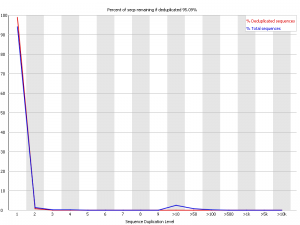
I wondering if there is any formula to estimate number of unique reads from FastQC Sequence Duplication Level output. For instance, in a set of 1M reads with 80% sequence duplication level what would be the estimated minimum and maximum of unique reads?
-
-
It would seem that the answer is 200,000 unique reads, but I don't know for sure.
You could download BBTools and run "dedupe.sh" on the dataset to get an exact number:
dedupe.sh in=reads.fq out=clean.fq
It works on single-ended or paired reads; for paired it only declares them duplicates if both reads match. Also, it supports variable #edits or substitutions, if you want, though by default it just looks for exact matches. -
Interpreting the FastQC duplication level plots is actually quite complicated.
See Simon Andrews' blog posts about this:
Comment
-
Thanks Brian and mastal for your comments and suggestions. I am only interested to know the number of unique reads from sequencing my libraries and I am reluctant to use any other tool since I get FastQC with other useful information. I wonder if someone could comment if a formula like this one: "(1-Sequence Duplication level%) x total number of reads= # of unique reads" will give correct answer or should some coefficients be factored in the formula.Comment
-
What I meant was, you can just run dedupe once on one dataset to confirm that the formula "(1-Sequence Duplication level%) x total number of reads= # of unique reads" is correct, or possibly derive a different formula, then go back to using FastQC. Dedupe prints the exact number (and percent) of duplicates.Comment


-
NGS has revolutionized clinical microbiology by offering new ways to identify and surveil pathogens without prior knowledge of the target. One popular approach is 16S rRNA and ITS amplicon sequencing, which targets specific microbial markers. But studies are increasingly incorporating shotgun metagenomics, a technique that sequences all DNA from a sample without targeting specific microbial markers. This approach allows more detailed taxonomic classification, detection...Today, 06:46 AM -
Tumors contain complex mixtures of cell populations that evolve in response to treatment and host-specific factors. Tissue biopsies provide only static snapshots of a tumor’s state. But what if we could follow that evolution over time using a minimally invasive technique?
Liquid biopsies can detect tumor-derived material circulating in the bloodstream, providing a way to study treatment response, detect emerging resistance, and discover new biomarkers. Circulating...10-14-2026, 09:55 AM
Comment