Unconfigured Ad

Collapse
X
 
  • Time
  • Show
Clear All
new posts
  • rich22
    Junior Member
    • Oct 2014
    • 1

    #1

    K-mer content and adapter contamination

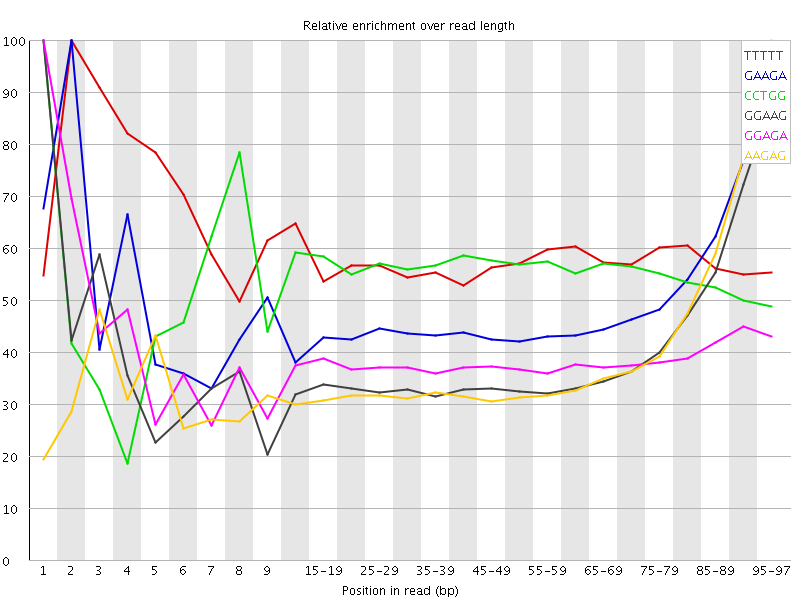
    Hi all, i am new to RNA-seq and i am using Galaxy to perform my analysis as part of a differential gene expression experiment. When using FASTQC to report on the quality of my data i see an over representation of the same k-mers ion the R2 reads of all my datasets. As you can see in the fastqc pictures the kmers GAAGA, GGAAG and AAGAG seem to be overepresented at the ends of my reads in the different datasets. I believe this may be indicative of adapter contamination but was unsure how to verify this and take steps to remove the contamination. Also can this contamination damage my TopHat alignments down the line.

    Thanks
    Richard


Latest Articles

Collapse

  • SEQadmin2
    Beyond CRISPR/Cas9: Understand, Choose, and Use the Right Genome Editing Tool
    by SEQadmin2


    CRISPR/Cas9 sparked the gene editing revolution for both research and therapeutics.1 But this system still showed severe issues that limited its applications. The most prominent were the heavy reliance on PAM sequences, delivery limitations, double-stranded breaks that prompt unintended edits and cell death, and editing inefficiency (both in targeting and in knock-in reliability).

    Despite this, “CRISPR helped turn genome editing from a specialized technique into
    ...
    07-31-2026, 11:01 AM
  • SEQadmin2
    Proteomic Platforms: How to Choose the Right Analytical Strategy to Improve Detection and Clinical Applications
    by SEQadmin2


    Proteomics platforms are evolving rapidly, with advances in mass spectrometry and affinity-based approaches expanding what researchers can detect and at what scale. As the field moves toward deeper proteome coverage and clinical applications, scientists face an increasingly complex landscape of tools. This article will explore how researchers are navigating these choices to find the right platform for their work.

    The systematic characterization of the human proteome has
    ...
    07-20-2026, 11:48 AM
  • SEQadmin2
    Advanced Sequencing Platforms Tackle Neuroscience’s Toughest Genomics Problems
    by SEQadmin2


    Genomics studies in neuroscience face a special challenge due to the brain’s complexity and scarcity of samples. Mapping changes in cell type and state using conventional next-generation sequencing methods remains challenging. Advances in technologies like single-cell sequencing, spatial transcriptomics, and long-read sequencing have opened the door to deeper studies of the brain and diseases like Alzheimer’s, amyotrophic lateral sclerosis (ALS), and schizophrenia.
    ...
    07-09-2026, 11:10 AM

ad_right_rmr

Collapse

News

Collapse

Topics Statistics Last Post
Started by SEQadmin2, 08-06-2026, 07:41 AM
0 responses
13 views
0 reactions
Last Post SEQadmin2  
Started by SEQadmin2, 08-03-2026, 10:13 AM
0 responses
31 views
0 reactions
Last Post SEQadmin2  
Started by SEQadmin2, 07-31-2026, 02:55 AM
0 responses
40 views
0 reactions
Last Post SEQadmin2  
Started by SEQadmin2, 07-24-2026, 12:17 PM
0 responses
26 views
0 reactions
Last Post SEQadmin2  
Working...