
Long non-coding RNAs (lncRNAs) are emerging as important regulatory molecules in developmental, physiological, and pathological processes. However, the precise mechanism and functions of most of lncRNAs remain largely unknown.
RBP-lncRNA Base, by analyzing millions of RNA-binding protein (RBP) binding sites from 117 CLIP-Seq datasets generated by 50 independent studies, we identified 22,735 RBP–lncRNA regulatory relationships.
1. We found that one single lncRNA will generally be bound and regulated by one or multiple RBPs, the combination of which may coordinately regulate gene expression.
2. We also revealed the expression correlation of these interaction networks by mining expression profiles of over 6000 normal and tumor samples from 14 cancer types.
3. Our combined analysis of CLIP-Seq data and genome-wide association studies data (GWAS) discovered hundreds of disease-related single nucleotide polymorphisms (SNP) resided in the RBP binding sites of lncRNAs.
RBP–lncRNA interactions were available at http://starbase.sysu.edu.cn/rbpLncRNA.php.
an invited paper described these protein–lncRNA interactions has been published in Frontiers journal.
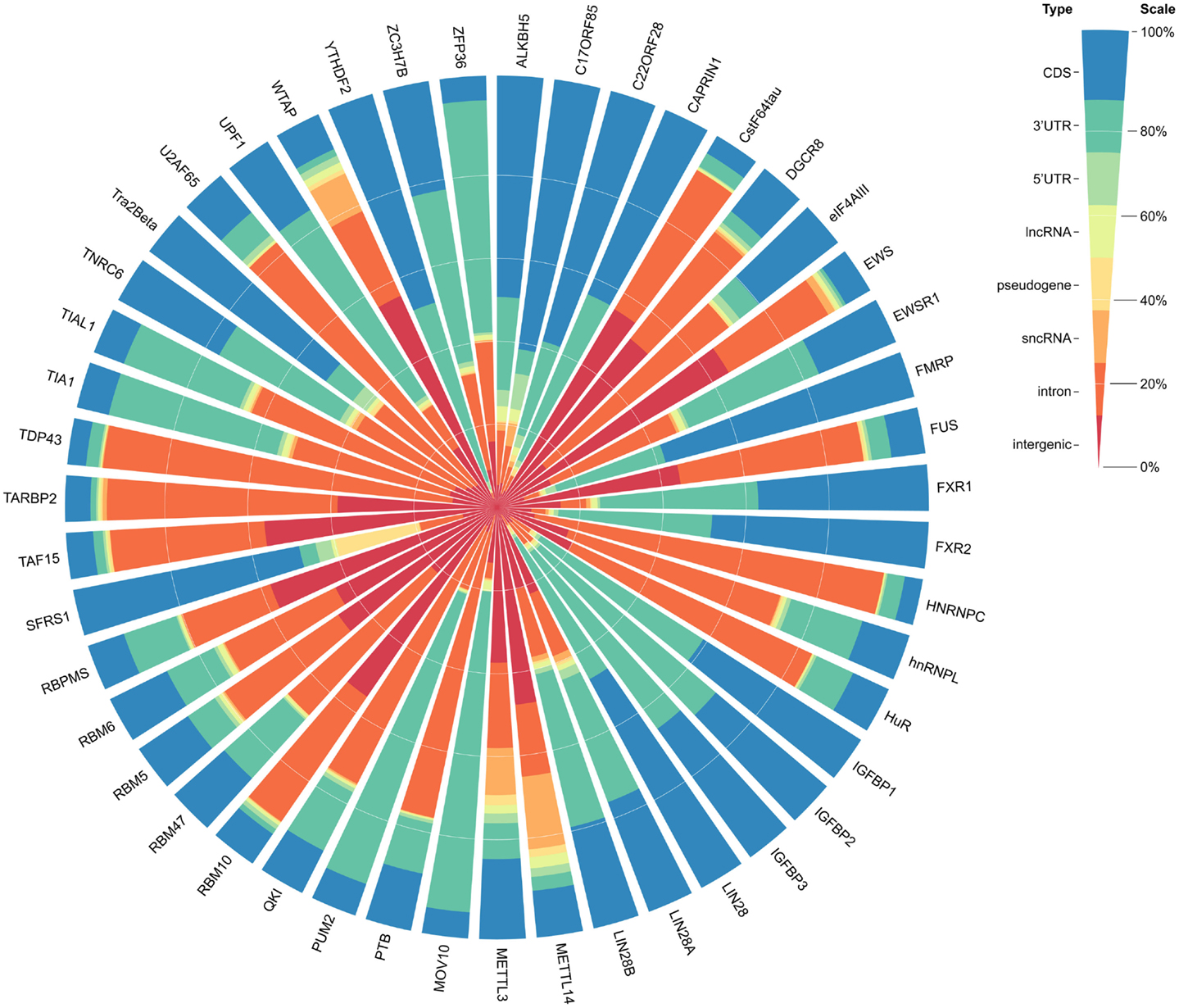
The genomic context distributions of binding sites for 47 human RBPs.
RBP-lncRNA Base, by analyzing millions of RNA-binding protein (RBP) binding sites from 117 CLIP-Seq datasets generated by 50 independent studies, we identified 22,735 RBP–lncRNA regulatory relationships.
1. We found that one single lncRNA will generally be bound and regulated by one or multiple RBPs, the combination of which may coordinately regulate gene expression.
2. We also revealed the expression correlation of these interaction networks by mining expression profiles of over 6000 normal and tumor samples from 14 cancer types.
3. Our combined analysis of CLIP-Seq data and genome-wide association studies data (GWAS) discovered hundreds of disease-related single nucleotide polymorphisms (SNP) resided in the RBP binding sites of lncRNAs.
RBP–lncRNA interactions were available at http://starbase.sysu.edu.cn/rbpLncRNA.php.
an invited paper described these protein–lncRNA interactions has been published in Frontiers journal.
The genomic context distributions of binding sites for 47 human RBPs.