
fastq format error
Hi Brian,
I found there is some format error with my fastq. By using reformat.sh in=in.fastq out=out.fastq, I get following error:
Input is being processed as unpaired
java.lang.AssertionError:
Error in in.fastq, line 4241767, with these 4 lines:
>m150430_235943_42146_c100804572550000001823173810081565_s1_p0/108988/0_3288 RQ=0.868
CTCTTTCCGGTAACACGCGCCTAGATACTAACAACCTACCTTATACTAATCAGCATGCCTAATACCAACA
ACCTACTTTATACCTAATAACAATGCCTTGATAACTAACAACATACCTTAATACCTAATACACGCTTAAT
ACCTAACAACAATACCTTAATACCTAACAACATACTTTAATACCTAACAACCTACCTTAATAACTTAATA
at stream.FASTQ.quadToRead(FASTQ.java:779)
at stream.FASTQ.toReadList(FASTQ.java:710)
at stream.FastqReadInputStream.fillBuffer(FastqReadInputStream.java:110)
at stream.FastqReadInputStream.nextList(FastqReadInputStream.java:95)
at stream.ConcurrentGenericReadInputStream$ReadThread.readLists(ConcurrentGenericReadInputStream.java:656)
at stream.ConcurrentGenericReadInputStream$ReadThread.run(ConcurrentGenericReadInputStream.java:635)
Input: 1060400 reads 9378503777 bases
Output: 1060400 reads (100.00%) 9378503777 bases (100.00%)
Time: 75.193 seconds.
Reads Processed: 1060k 14.10k reads/sec
Bases Processed: 9378m 124.73m bases/sec
Exception in thread "main" java.lang.RuntimeException: ReformatReads terminated in an error state; the output may be corrupt.
at jgi.ReformatReads.process(ReformatReads.java:1130)
at jgi.ReformatReads.main(ReformatReads.java:45)
Could you please provide any suggestions on which steps shoud I follow to find the exact error of that read?
Thanks!
-
No, I've never implemented something like that... the closest you could get with the existing package is to use a loop for each length with something like...Originally posted by Dinab View Post
Code:reformat.sh in=reads.fq minlen=147 maxlen=147 out=stdout.fq int=f | reformat.sh in=stdin.fq aqhist=aqhist_147.txt
Leave a comment:
-
Another question
Hi Brian,
Your previous response worked perfectly, thank you again.
I now have additional complexity to add: is it possible to get a plot of the mean quality of each sequence as variable of the length?Leave a comment:
-
Yes, the histogram section of the help covers that. Depending on how you want to plot it, you can use qhist, qchist, aqhist, or bqhist. The most generic is aqhist, which plots the number of reads per average quality score.Originally posted by Dinab View Post
"maq" transforms the qualities into probability space, calculates the average error rate, and then transforms that back into the phred scale. So, a 2% maximum error rate would be approximately maq=17.Also, if I use reformat.sh with maq=XX, does it simply calculates the average quality based on base quality and checks the error rate (2% max)?Leave a comment:
-
Quality distribution graph
A bit late, but hope you can help me:
I want to create an average quality distribution graph of multiple sequences from fastq file. Is it possible with reformat?
Also, if I use reformat.sh with maq=XX, does it simply calculates the avvarge quality based on base quality and checks the error rate (2% max)?
Thank you!Leave a comment:
-
IGV needs a sorted, indexed bam file. It won't accept sam.Originally posted by JVGen View Post
Please send me the links, and I'll look at them.I shared the SAM file with you on google drive. I included the trimmed, normalized, unassembled reads and the reference as a separate FASTA as well, just in case.
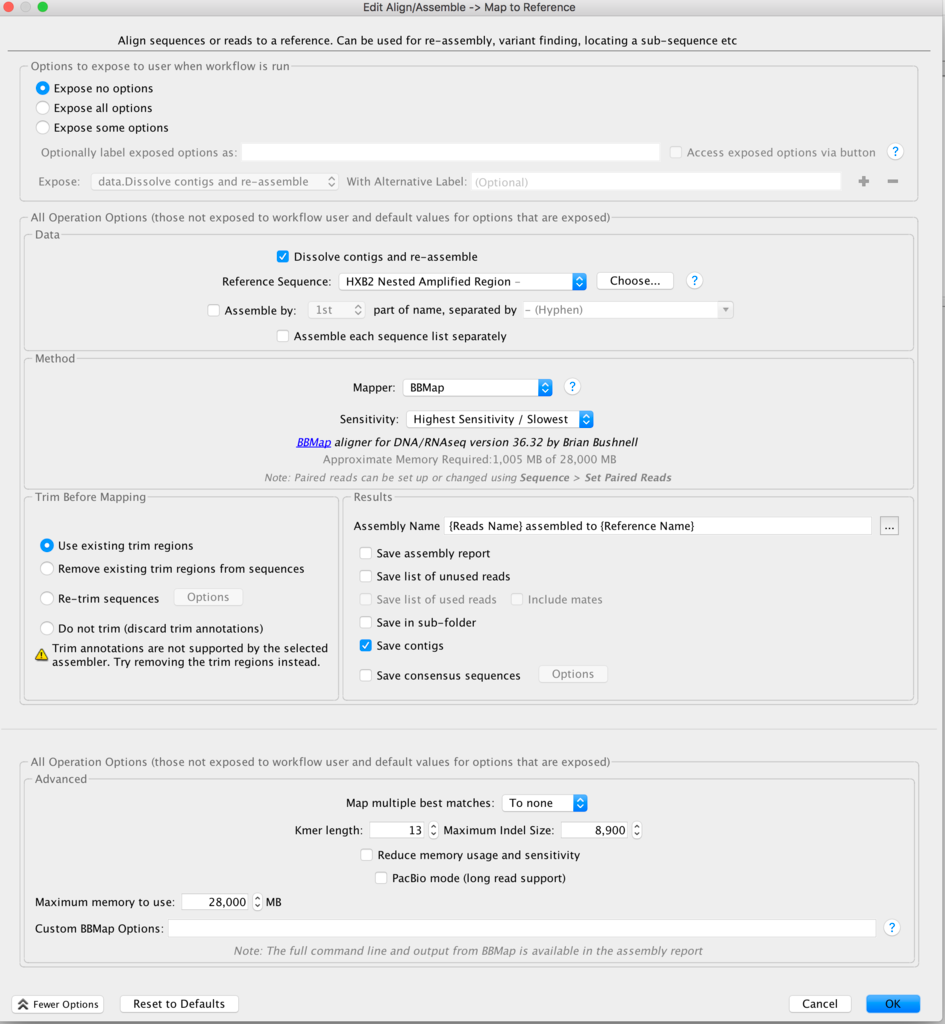
Hmmm, I'm not really sure what Geneous is doing behind the scenes here with regards to trimming, but it doesn't look like it would have any kind of effect that would suppress long deletions.I'm running it in Geneious with the following parameters (in picture). I'm going to try ticking the "discard trimmed regions", though I think it is unnecessary, because I don't think BBDuk keeps trimmed information (which is how I trimmed the reads). Dissolve contigs is redundant - no contigs have yet been assembled. Quirk of the program.Leave a comment:
-
Hi Brian, that's Geneious I'm viewing in. I download and tried using IGV, but I get an error when trying to load up the SAM file. I shared the SAM file with you on google drive. I included the trimmed, normalized, unassembled reads and the reference as a separate FASTA as well, just in case.Originally posted by Brian Bushnell View Post
This could be, but they replace no coverage with gaps, so I don't know what the program is doing behind the scenes (if it's logging D's or N's). I will try repeating with this flag and see if it changes the outcome.Originally posted by Brian Bushnell View Post
I'm running it in Geneious with the following parameters (in picture). I'm going to try ticking the "discard trimmed regions", though I think it is unnecessary, because I don't think BBDuk keeps trimmed information (which is how I trimmed the reads). Dissolve contigs is redundant - no contigs have yet been assembled. Quirk of the program.Originally posted by Brian Bushnell View Post
There is a ~3.5kb deletion on the 3' end of the HIV genome. The HIV reference sequence is depicted in the faded yellow box. Reads assembled to the reference are depicted below as black rectangles (which, when I zoom in, show their sequence). A coverage map is shown above the reference in red. A consensus sequence for the assembled reads is provided above the coverage map. Within the consensus, black represents a mismatch to the reference (this many mismatches is not uncommon for HIV, as it's a retrovirus and reverse transcription introduces many mutations).Originally posted by Brian Bushnell View Post
Thanks for any help!
JVLeave a comment:
-
The default maxindel should be fine in this case. If there are reads spanning the deletion, they will be mapped spanning the deletion. I'm not familiar with the viewer you are using... perhaps you could try IGV?
"intronlen=10" will, for example, replace "D" (deletion) symbols in cigar strings with "N" (skipped) symbols, for deletions of at least 10bp in length. Some programs and viewers prefer N over D for whatever reason. I consider them equivalent. But, it's possible the viewer you are using does not properly display reads with "D" symbols in the cigar string, so using IGV or remapping with the "intronlen=10" flag might be helpful. Or, if you send me the sam file and reference I can look at it.
I'm not sure what you mean by that - can you clarify? Also, can you give the exact command you used for BBMap? If you use the "local" flag, long deletions might get erased.most of these reads were trimmed so that the consensus would reflect the correct deletion
I've honestly never heard a concern before that BBMap was unwilling to map reads spanning long deletions - only the opposite. In your last picture, it looks to me like all of the reads are mapped with a long deletion extending off the screen to the left; or am I misinterpreting it?Leave a comment:
-
@JVGen: Are you using default alignment settings for bbmap? You may need to adjust maxindel (which defaults to 16000) and intronlen settings.Leave a comment:
-
Hi Brian,Originally posted by Brian Bushnell View Post
I am trying to use BBMap to align 150 bp paired end reads to a 10 kb reference. The reference is an HIV genome, and my sequencing input is PCR amplified HIV proviruses (means I get lots of coverage).
I use BBDuk to adapter and quality trim my reads. I then used BBNorm to normalize coverage to ~150. Then I used BBMap to map the reads to the reference.
Deletions in HIV proviruses are common, and I noticed that BBMap seems to get hung up near the deletions. For instance, if a read spans the deletion, BBMap doesn't seem to insert a gap into the read so that it aligns on the other size of the deletion. I've attached some pictures. First pic is the full alignment, second 5' of the deletion, third 3' of the deletion. Note that the "CTGAGGGGACAGAT" sequence is present on the reads on the 5' side of the deletion, and should extend to the 3' side. In this case, most of these reads were trimmed so that the consensus would reflect the correct deletion, but I do worry that this might not always be the case.
Are there any settings to adjust this to allow the reads to span the deletion?
Thanks,
Jake

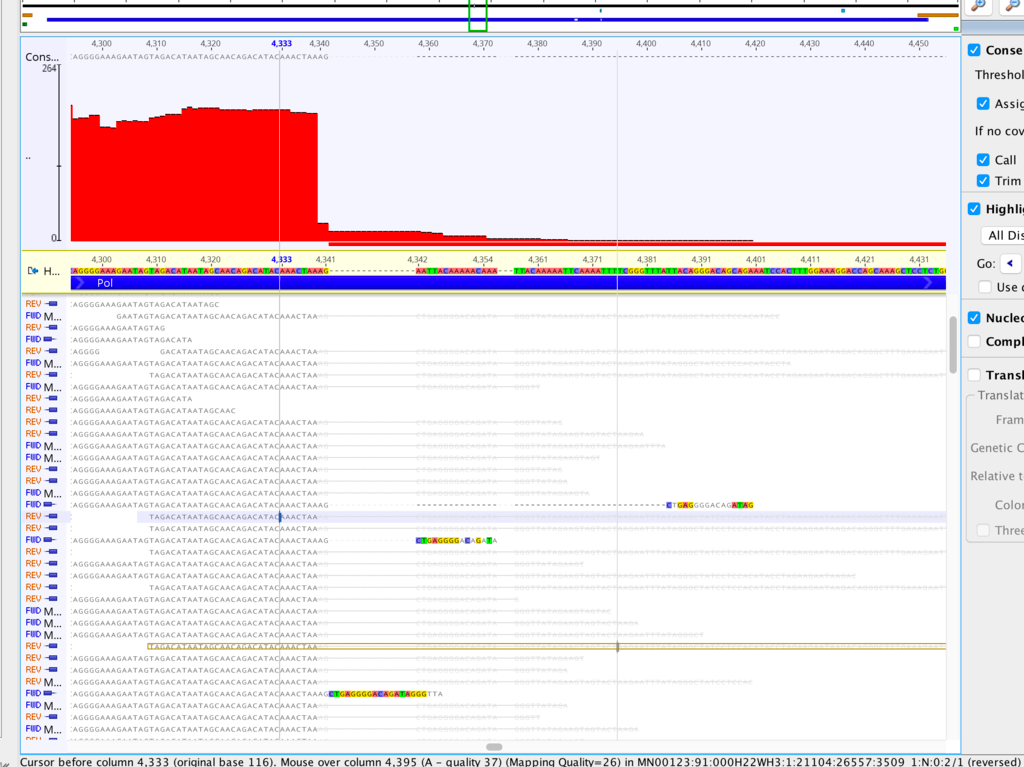
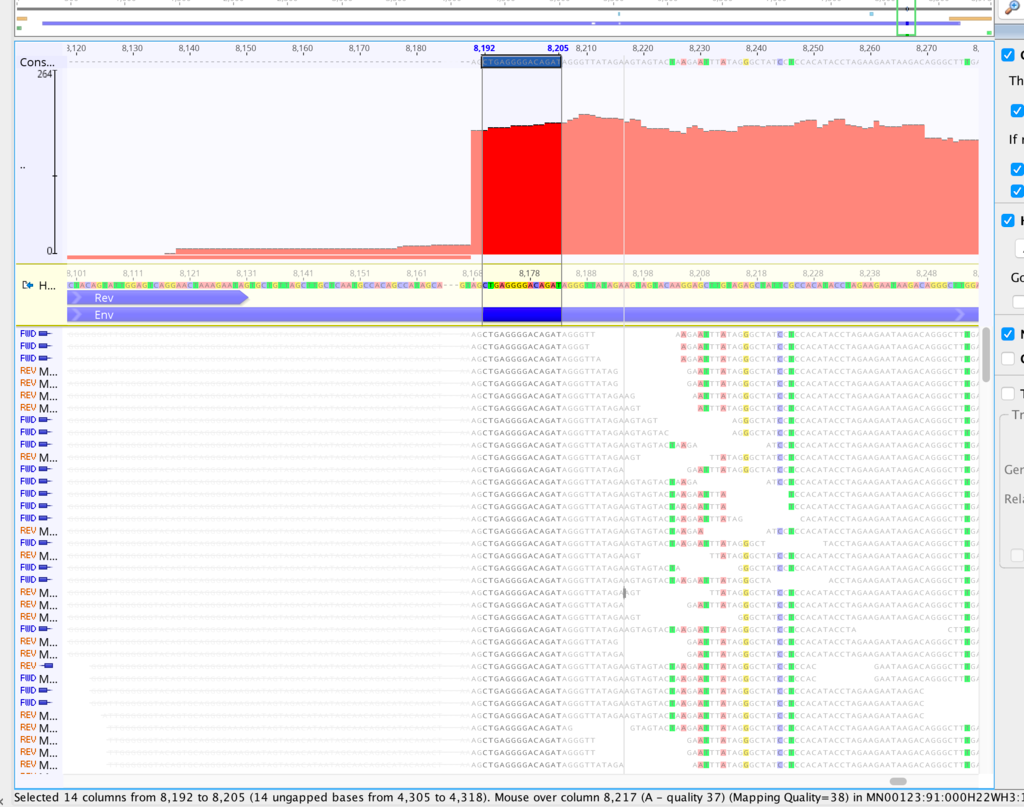
Leave a comment:
-
Oh, very well, I'll add it to the listOriginally posted by GenoMax View Post
Leave a comment:


-
Tumors contain complex mixtures of cell populations that evolve in response to treatment and host-specific factors. Tissue biopsies provide only static snapshots of a tumor’s state. But what if we could follow that evolution over time using a minimally invasive technique?
Liquid biopsies can detect tumor-derived material circulating in the bloodstream, providing a way to study treatment response, detect emerging resistance, and discover new biomarkers. Circulating...10-14-2026, 09:55 AM -
Researchers using sequencing and genomics tools often have to make trade-offs. They can choose between speed or scale, short reads or long-range information, or targeted panels or a view of the whole transcriptome. New technologies that have been released this year are built to address those tough choices.
We asked six companies the same four questions to learn about their latest products. The new technologies bring a lot to the table, including rethinking sequencing...
Leave a comment: