Unconfigured Ad

Collapse
X
 
  • Filter
  • Time
  • Show
Clear All
new posts
  • danwiththeplan
    Member
    • Sep 2011
    • 72

    shiny_cuffdiff: On-the-fly interrogation and plotting of gene expression results

    Hi all. I'd like to introduce the community to shiny_cuffdiff


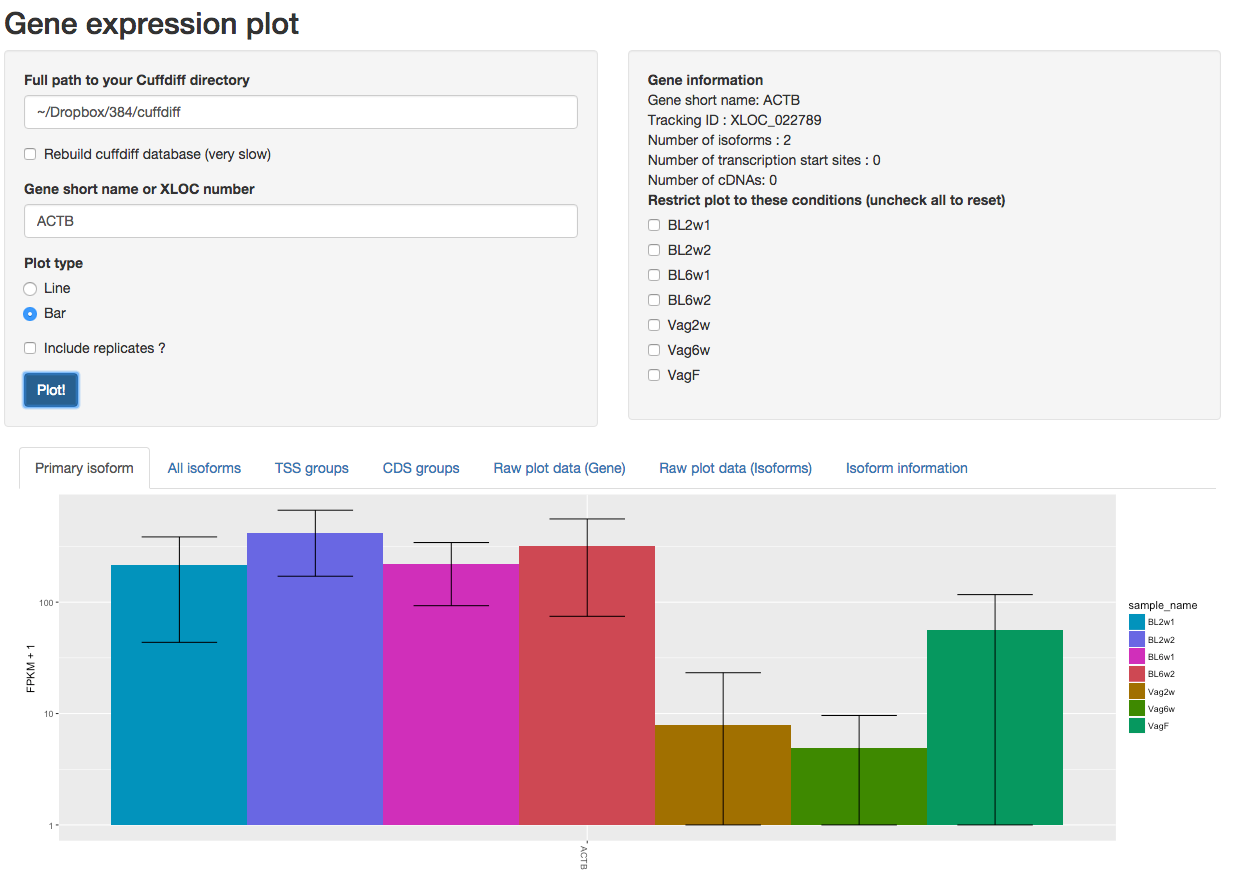
    Put simply, this code uses the outputs of the Tuxedo workflow (Tophat2 > Cufflinks > Cuffdiff) which is a cuffdiff SQL database file called cuffdiff.db. Then, using the R package cummeRbund, various plots and outputs are created on-the fly.

    shiny_cuffdiff consists of two Shiny apps:

    gene_expression_panel_cuffdiff:

    Takes a cuffdiff database (rebuilding if required) and displays information on a single named gene (as defined by the gene short name or the XLOC number). After the gene information is defined, gene expression plots can be restricted by sample.

    gene_comparison_panel_cuffdiff:

    Takes a cuffdiff database (rebuilding if required) and displays information on a set of named genes (as defined by the gene short name or the XLOC number). Displays a heatmap and a barplot. After the gene information is defined, gene expression plots can be restricted by sample.

    This project is at an early phase of development, but is under active development.

    Participants (either users, testers, or code developers) are encouraged!


    We are also developing Shiny code to interrogate the outputs of other common gene expression / differential expression workflows (initially starting with DESeq2), which will be published as a separate repository.

    Dan Jones
    School of Biological Sciences
    The University of Auckland

    Please feel free to contact me through SeqAnswers or Github.
    Last edited by danwiththeplan; 01-24-2016, 07:42 PM.
  • Zapages
    Member
    • Oct 2012
    • 98

    #2
    Hi

    I was just testing the program out. This seems to be a great way to help non-Bioinformaticians to visualize their differential expression data.

    There is an extra ")" at the end of the code to run it through shiny in R.

    Have you considered something like this: QuickRNASeq http://sourceforge.net/projects/quickrnaseq/ or Degust: http://vicbioinformatics.com/degust/...?code=example#
    Last edited by Zapages; 01-25-2016, 10:36 AM.

    Comment

    • danwiththeplan
      Member
      • Sep 2011
      • 72

      #3
      Hi, thanks for your reply. I'm not able to replicate this error. If you mean this error:
      Code:
      error in evaluating the argument 'object' in selecting a method for function 'expressionPlot': Error in sqliteSendQuery(con, statement, bind.data) : 
        error in statement: near ")": syntax error
      ..then this occurs when you aren't giving the program a valid cuffdiff directory (not the cuffdiff.db file, the cuffdiff directory), or the gene name or XLOC number does not exist. Note that the plotting isn't instant, if you can see cummeRbund getting the gene information:

      Code:
      Getting gene information:
      	FPKM
      	Differential Expression Data
      	Annotation Data
      	Replicate FPKMs
      	Counts
      .then it's working and the plots will pop up soon.

      This is not so much an error in the code, more an example of error handling that could be more clear and informative. As is noted, this is a program in early development and I do note that error handling is the next thing I'm working on. Additionally, the plots are not that nice, so I will be using ggplot2 to make nicer plots in the very near future.

      I'm aware of Degust and QuickRNAseq. Degust does something very similar but does not handle cuffdiff outputs at all. Valid comparison, but until they add capability to handle cuffdiff, I think this work has a place. Additionally Degust requires that you upload your data (EDIT: you can download the code and run it on your computer, so I'm wrong here)
      Not sure the comparison to QuickRNAseq is valid, since it's an entire workflow that starts right from the FASTQ file (as I understand it).
      Last edited by danwiththeplan; 01-25-2016, 01:01 PM.

      Comment

      • lgoff
        Member
        • Feb 2008
        • 82

        #4
        Really interesting project. Looking forward to contributing to it's development. Thanks for picking up this mantle.

        -Loyal

        Comment

        • Zapages
          Member
          • Oct 2012
          • 98

          #5
          Yes, I agree this work definitely is useful and has a place. As this could be specifically designed for cuffdiff and other R based tool sets.

          Currently, using gplot2 to create heatmaps takes a bit of time with R for DeSeq and EdgeR data.

          I was able to fix the error, by going into the load_packages.R files and fixing up the URL addresses. My R was not accepting the 's' in https://...

          I look forward to future versions of your tool.

          Best Regards.

          Comment

          • danwiththeplan
            Member
            • Sep 2011
            • 72

            #6
            Originally posted by Zapages View Post
            Yes, I agree this work definitely is useful and has a place. As this could be specifically designed for cuffdiff and other R based tool sets.

            Currently, using gplot2 to create heatmaps takes a bit of time with R for DeSeq and EdgeR data.

            I was able to fix the error, by going into the load_packages.R files and fixing up the URL addresses. My R was not accepting the 's' in https://...

            I look forward to future versions of your tool.

            Best Regards.
            Great, thanks, this is now fixed. Prettier plots (using ggplot2) are definitely a plan for the near future. Hoping to get publication-level plots that can be generated on the fly. To avoid spamming Seqanswers, it might be better to keep bug reports as personal messages or in github.

            Questions and clarifications on how to use the software are fine

            Comment

            • Zapages
              Member
              • Oct 2012
              • 98

              #7
              Hi

              I just tested the program out again with all of my RNA-Seq datasets. It works really great. Thank you for creating this application.

              Maybe to help users create publication like graphs/charts, maybe there could be an option to save the images as *.svg files. This could allow the user to edit svg file (with svg editors) and have publication like results.

              Also if I were to use this for publication. How should we cite the application?

              Many thanks in advance.

              -Zain

              Comment

              • danwiththeplan
                Member
                • Sep 2011
                • 72

                #8
                Originally posted by Zapages View Post
                Hi

                I just tested the program out again with all of my RNA-Seq datasets. It works really great. Thank you for creating this application.

                Maybe to help users create publication like graphs/charts, maybe there could be an option to save the images as *.svg files. This could allow the user to edit svg file (with svg editors) and have publication like results.

                Also if I were to use this for publication. How should we cite the application?

                Many thanks in advance.

                -Zain
                Thanks for the feedback! To answer your questions:

                1) For future releases, we will include citation information, but for now, please cite:

                Jones,D., Stuckey, A., and Fan, V. (2016). shiny_cuffdiff (version 0.1): On-the-fly interrogation and plotting of gene expression results. http://nzgl.github.io/shiny_cuffdiff/

                Remember to also cite the underlying R code (cummeRbund) and the Tuxedo workflow.

                2) Excellent suggestion regarding .svg files. I will add this to the list of features we are implementing. The ability to save graphics in various formats is definitely on the to-do list.

                Following the project on Github is a good idea, as we are actively working on new features and better error handling. For example, we have already implemented better methods of selecting the database file and are working on making the graphics more visually pleasing and customisable. We expect to release version 0.2 early next week, so keep an eye out!

                Again, thanks for the feedback, please Star us on Github!
                Last edited by danwiththeplan; 02-03-2016, 05:39 PM.

                Comment

                • MikhailFokin
                  Member
                  • Mar 2014
                  • 15

                  #9
                  nice a bit scary to have it in a browser...
                  what the "include replicates" option means?

                  Comment

                  Latest Articles

                  Collapse

                  • SEQadmin2
                    From Collection to Sequencing: Why Sample Preparation and Preservation Define Sequencing Data
                    by SEQadmin2


                    Data variability is still an issue in sequencing technologies despite the advances in reproducibility and accuracy of these platforms. But the problem does not originate in the sequencing itself, but in the previous steps, before the sample reaches the sequencer.


                    The first step is collection, followed by preservation and sample preparation for analysis. Most scientists overlook those steps, but not being careful might just be skewing the experiment’s results.
                    ...
                    06-02-2026, 10:05 AM
                  • SEQadmin2
                    Single-Cell Sequencing at an Inflection Point: Early Impacts of New Platforms and Emerging Trends
                    by SEQadmin2


                    With the launch of new single-cell sequencing platforms in 2026, the field stands at an exciting inflection point. This article surveys the most impactful advances in the field and discusses how they’re reshaping research in cancer, immunology, and beyond.


                    Introduction

                    Single-cell sequencing technologies have undergone remarkable advances over the past decade, transitioning from low-throughput experimental approaches to highly scalable platforms capable of...
                    05-22-2026, 06:42 AM
                  • SEQadmin2
                    Environmental Genomics in the Age of NGS: From Microbes to Conservation Strategies
                    by SEQadmin2

                    Studying ecosystems means dealing with complex, multi-species communities that are hard to observe at scale. This complexity, however, hides many important questions to be answered, from how biogeochemical cycles work and how climate change can affect species distribution to how conservation strategies can work best.


                    Genomics, particularly since the expansion of NGS, has transformed ecosystem ecology. By sequencing environmental DNA, we can now assess biodiversity without direct...
                    05-06-2026, 09:04 AM

                  ad_right_rmr

                  Collapse

                  News

                  Collapse

                  Topics Statistics Last Post
                  Started by SEQadmin2, 06-02-2026, 12:03 PM
                  0 responses
                  21 views
                  0 reactions
                  Last Post SEQadmin2  
                  Started by SEQadmin2, 06-02-2026, 11:40 AM
                  0 responses
                  14 views
                  0 reactions
                  Last Post SEQadmin2  
                  Started by SEQadmin2, 05-28-2026, 11:40 AM
                  0 responses
                  29 views
                  0 reactions
                  Last Post SEQadmin2  
                  Started by SEQadmin2, 05-26-2026, 10:12 AM
                  0 responses
                  31 views
                  0 reactions
                  Last Post SEQadmin2  
                  Working...