Unconfigured Ad

Collapse
X
 
  • Time
  • Show
Clear All
new posts
  • heso
    Member
    • May 2014
    • 19

    #1

    How to pile up reads and get per base coverage?

    Hi,

    I have list of sequences (17-35bases) with sequence read count in column 1.
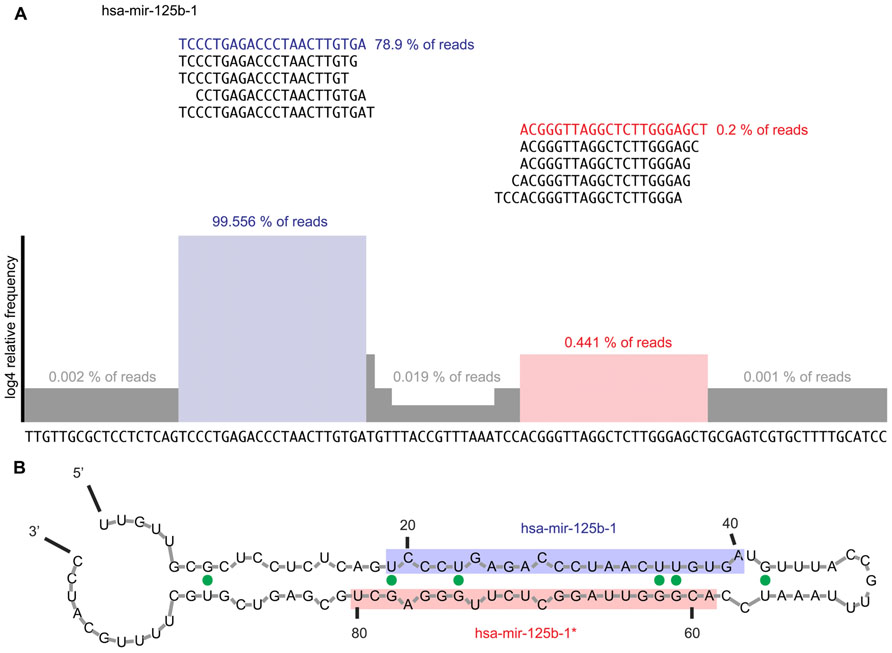
    I would like to see the end processing patterns of these sequences (to pile up similar ones and get the per-base coverage).

    E.g. two sequences in my input file:
    Code:
          4 TTGATCCTTCGATGTCGGCTCTTCCT
        30 ATCCTTCGATGTCGGCTCTTCCTATCATT
    alignment of these sequences would look like that:
    Code:
     TTGATCCTTCGATGTCGGCTCTTCCT
        ATCCTTCGATGTCGGCTCTTCCTATCAT
    So the coverage of the first 3 nucleotides (TTG) is read count=4, for ATCCTTCGATGTCGGCTCTTCCT its 30+4=34 and for ATCAT it's 30


    In principle, the end result/graph should look like this one here:


    I know bedtools can output genomic coverage, but I'm afraid it won't be useful here...Does anybody have an idea how to solve this? I also have .sam files containing the same sequences, if that's of any help...


    Thanks in advance
    Last edited by GenoMax; 09-06-2017, 07:52 AM.
  • aprice67
    Member
    • Nov 2012
    • 49

    #2
    Hi,

    I have a script that does that from my PhD days. I actually used this for some RNA secondary structure projects, so it looks like you're working on something similar.

    Uploaded scripts. Contribute to price0416/scripts development by creating an account on GitHub.


    Disclaimer: I wrote this like 4 years ago and don't remember exactly all the details of it, so be sure to examine the code for yourself, it's not very long.

    Hope this helps!
    Last edited by aprice67; 09-07-2017, 11:44 AM. Reason: spelling

    Comment

    Latest Articles

    Collapse

    • SEQadmin2
      Multiomic Liquid Biopsy: What DNA/RNA Panels Reveal That DNA Alone Can’t
      by SEQadmin2


      Tumors contain complex mixtures of cell populations that evolve in response to treatment and host-specific factors. Tissue biopsies provide only static snapshots of a tumor’s state. But what if we could follow that evolution over time using a minimally invasive technique?

      Liquid biopsies can detect tumor-derived material circulating in the bloodstream, providing a way to study treatment response, detect emerging resistance, and discover new biomarkers. Circulating
      ...
      10-14-2026, 09:55 AM
    • SEQadmin2
      New Genomics Technologies Take Aim at Long-Standing Limits
      by SEQadmin2


      Researchers using sequencing and genomics tools often have to make trade-offs. They can choose between speed or scale, short reads or long-range information, or targeted panels or a view of the whole transcriptome. New technologies that have been released this year are built to address those tough choices.

      We asked six companies the same four questions to learn about their latest products. The new technologies bring a lot to the table, including rethinking sequencing
      ...
      09-28-2026, 10:25 AM

    ad_right_rmr

    Collapse

    News

    Collapse

    Topics Statistics Last Post
    Started by SEQadmin2, Yesterday, 10:52 AM
    0 responses
    11 views
    0 reactions
    Last Post SEQadmin2  
    Started by SEQadmin2, 10-14-2026, 05:39 AM
    0 responses
    19 views
    0 reactions
    Last Post SEQadmin2  
    Started by SEQadmin2, 10-13-2026, 09:56 AM
    0 responses
    18 views
    0 reactions
    Last Post SEQadmin2  
    Started by SEQadmin2, 10-09-2026, 11:14 AM
    0 responses
    27 views
    0 reactions
    Last Post SEQadmin2  
    Working...