
Sometimes, especially on the new Illumina flowcells, the indices get swapped around onto molecules they didn't originally belong to. With non-unique dual indices, where any combination of the index pool is potentially valid, that problem is invisible -- some of your reads *actually* belong to one library but have the indices for another library. With unique-dual-indexing, the problem still occurs, but it's not invisible -- any index-hopping or index-swapping will result in a read with an invalid combination of indices, and so it'll get kicked to the "Undetermined" set. You still "lost" that read, but it didn't get erroneously assigned to a different library.
Unique-dual-indexing *is* basically single-indexing, but you've got two barcodes, and the likelihood that both barcodes get swapped to something valid is practically nil.
-
Your statement is correct but UDI addresses another issue (index hopping) in patterned flow cells used in HiSeq 3000/4000 HiSeqX and NovaSeq to maintain fidelity of reads assigned to multiplexed libraries. Links in post #1 should give you some information on the issue.Originally posted by HeinKey View PostLeave a comment:
-
perhaps this question is asked before, but I don't understand the added value of dual indexing over single indexing anymore if both indices are unique in dual indexing. The highest possible complexity is then equal to highest complexity of single indexing.
What do I miss?Leave a comment:
-
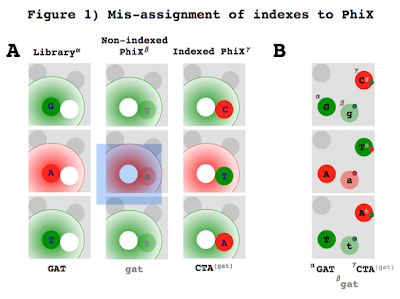
IIRC, James Hadfield wrote up a very nice article on enseqlopedia showing how PhiX reads can get mis-associated with sample index sequences (when using Illumina's non-indexed PhiX) on patterned flow cells (like HiSeq 4K, X, and NovaSeq). If you do run PhiX with your samples on patterned flow cells at anything more than 1%, I'd suggest using indexed PhiX like the stuff SeqMatic sells. They'll even make you some PhiX with index sequences you specify (if desired).Leave a comment:
-
Unknown reads source in indexed sequencing:
1- PhiX
2- indices that does not match those in sample sheet caused by base mis-match in excess of set numbers in bcl2 fastq. This is result of poor sequence quality due to over clustering or adapter/primer quality
Unknown reads are high when using desalted primers for amplicon librariesLeave a comment:
-
On that note, what is an unusually high percentage of unknown reads?Leave a comment:
-
I am just reading between the lines and assume that a pool of library was sequenced on both machines and a particular library yielded more reads on HiSeq than MiSeq. Some possible explanations:
1- different pooling ratio
2- differences in library size distribution
3- residual adapter in some libraries resulting in increased index hopping
I would do a demultiplexing of HiSeq reads with all index combinations to see if there has been unusual index hopping among some libraries (libraries with high index hopping will have less reads) and also pay attention to the number of unknown readsLeave a comment:
-
I think it would be helpful to us to know where you got your indices from, as nucacidhunter mentioned. I don't know if it's possible, but perhaps the indices from Illumina are selected because they work very well on the HiSeq. Since the way that they cluster is different, I *could* see it being possible that certain sequences on the HiSeq perform better than on the MiSeq. But I really can't imagine why that would be so, unless certain parts of the sequence upstream of the flow-cell adapter are better for the recombinase enzyme that the HiSeq uses?
It could also be a function of the libraries themselves, and NOT the indices. Were your libraries all of uniform size distribution? I've observed that the MiSeq can be very sensitive to the presence of long (>800bp) inserts -- those molecules simply won't cluster as well as the shorter inserts. If the poor-on-MiSeq library had larger inserts than the other libraries, that could explain why it didn't form as many clusters on the MiSeq flowcell, but was able to form clusters well on the HiSeq.
I feel your frustration. Clustering is some kind of mystical voodoo to those of us who don't work at Genomics cores and don't have tons of experience with the way different libraries cluster on different platforms. I'm dealing with this myself right now -- wide spread of representation over 50+ libraries, only *partly* explained by an aggressive Pippin prep.Leave a comment:
-
Thanks Innovelty and Nucacidhunter for your replies!
The problem i see here is that the libraries containing UDIs when an aliquot is run on Miseq show different index representation than the one run on HiseqX!!
i.e UDI pair poorly performing on Miseq is actually the best one on HiseqX! Why so?Last edited by systembio; 01-17-2018, 01:46 PM.Leave a comment:
-
They work fine on NovaSeq and HS4000 and should be fine on MiSeq too as Innovelty has mentioned.Originally posted by systembio View Post
I wonder if you have used adapters directly from IDT or Illumina branded plates from Illumina. It will be interesting and useful if you could describe the issue that you have seen.Leave a comment:
-
Thanks for bumping this thread up again, systembio.
From what I know about the MiSeq chemistry (and it was the first sequencing platform I used) the unique dual indices shouldn't be a *problem* for MiSeq. Libraries made with UDI will sequence just fine on a MiSeq. They're unecessary, because MiSeq does not have the index-hopping problem that the HiSeq does, because the MiSeq's cluster-formation process is different. But definitely doing a little MiSeq nano run of your libraries to make sure they're what you wanted would be fine, prior to a HiSeq run. (If I'm wrong about this, though, I am sure someone will correct me!)
To answer my own question from a few months ago, the barcodes must be unique at both ends, but they don't have to be "the same index" at each end. Just each p5 index can only be used once, and each p7 index can only be used once, so each library gets a unique PAIR of indices. (Since I was struggling with it awhile back, I think I might as well clarify it for anyone else.) We ended up sequencing at Berkeley's genomics core, and they sell plates of UDI. Very pleased with them.Leave a comment:
-
Has anyone used IDT unique dual indexes on various Illumina sequencing platforms? Do UDIs behave differently on Miseq (v3 chemistry) vs HiseqX? Does a Miseq chemistry has a role to play in index representation?Leave a comment:




-
NGS has revolutionized clinical microbiology by offering new ways to identify and surveil pathogens without prior knowledge of the target. One popular approach is 16S rRNA and ITS amplicon sequencing, which targets specific microbial markers. But studies are increasingly incorporating shotgun metagenomics, a technique that sequences all DNA from a sample without targeting specific microbial markers. This approach allows more detailed taxonomic classification, detection...Today, 06:46 AM -
Tumors contain complex mixtures of cell populations that evolve in response to treatment and host-specific factors. Tissue biopsies provide only static snapshots of a tumor’s state. But what if we could follow that evolution over time using a minimally invasive technique?
Liquid biopsies can detect tumor-derived material circulating in the bloodstream, providing a way to study treatment response, detect emerging resistance, and discover new biomarkers. Circulating...10-14-2026, 09:55 AM
Leave a comment: