Unconfigured Ad

Collapse
X
 
  • Time
  • Show
Clear All
new posts
  • wynstep
    Member
    • Jan 2014
    • 11

    #1

    Correlation FPKM and RPKM

    Hi everyone!
    I'm trying to evaluate gene expression differences, in breast cancer cells before and after treatment. So I'm working on RNA-seq data (single-end reads).

    I tried to correlate FPKM (CuffDiff output) and RPKM (counts from HTSeq-count, then classic "Mortazavi et al." calculation).
    Reading the CuffLinks website, some papers and other forums, it seems that these values have to be the same for single-end reads data!

    I also filtered miRNAs and other genes shorter then 300bp (could give false FPKM high values).
    I hope that someone can help me!

    Thanks in advace
  • rboettcher
    Member
    • Oct 2010
    • 71

    #2
    You did not include a question or any findings in your post, so what exactly do you want to know?

    Comment

    • dpryan
      Devon Ryan
      • Jul 2011
      • 3478

      #3
      For single-end reads, FPRKM==RPKM. Keep in mind that, due to how it works, the RPKM values produced by cufflinks will almost never be the same as those you compute by hand. Firstly, htseq-count only count uniquely mapped reads, whereas cufflinks will distribute fractional reads counts over transcripts and genes. Also, you likely have a single pre-defined length for each gene, presumably computed by just summing the length of each exon in a "union gene model". I recall that cufflinks tries to determine the actual length and distributions of the transcripts and then uses that.

      BTW, unless you really want to discover new isoforms or genes, you might just directly use the counts from HTSeq-count in DESeq2 (or edgeR or limma).

      Comment

      • wynstep
        Member
        • Jan 2014
        • 11

        #4
        Sorry, you're right! My question is:
        Is possible to obtain equal FPKM and RPKM values? All says "yes", but deeply searching into the literature, I didn't find a protocol to do it or some correlation analysis.

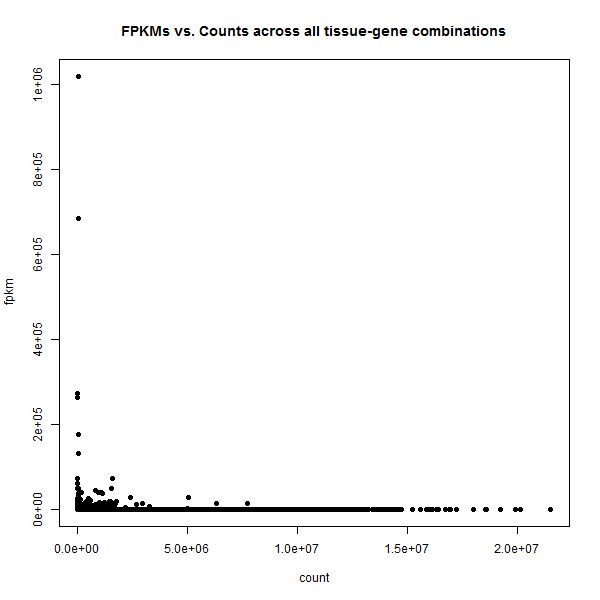
        The best match I've found is this:

        but he tried to correlate crude counts to fpkm (without a great success...)

        Thanks!

        Comment

        • dpryan
          Devon Ryan
          • Jul 2011
          • 3478

          #5
          By definition, an FPKM value computed with single-end reads is also the RPKM value (in fact, this is also true for paired-end reads if you only use reads where both ends map to the same feature). As I mentioned above, the reason that you're getting different values by hand than by cufflinks is that you're using vastly different methods to arrive at both counts and lengths.

          Comment

          • wynstep
            Member
            • Jan 2014
            • 11

            #6
            Originally posted by dpryan View Post
            For single-end reads, FPRKM==RPKM. Keep in mind that, due to how it works, the RPKM values produced by cufflinks will almost never be the same as those you compute by hand. Firstly, htseq-count only count uniquely mapped reads, whereas cufflinks will distribute fractional reads counts over transcripts and genes. Also, you likely have a single pre-defined length for each gene, presumably computed by just summing the length of each exon in a "union gene model". I recall that cufflinks tries to determine the actual length and distributions of the transcripts and then uses that.

            BTW, unless you really want to discover new isoforms or genes, you might just directly use the counts from HTSeq-count in DESeq2 (or edgeR or limma).
            sorry for my ignorance, what's the meaning of FPRKM? Thanks for your answer!
            The reason why I tried to compare FPKM and RPKM, is only to have a value control!
            I believe that I have to follow only one strand of analysis...

            Comment

            • wynstep
              Member
              • Jan 2014
              • 11

              #7
              Originally posted by dpryan View Post
              By definition, an FPKM value computed with single-end reads is also the RPKM value (in fact, this is also true for paired-end reads if you only use reads where both ends map to the same feature). As I mentioned above, the reason that you're getting different values by hand than by cufflinks is that you're using vastly different methods to arrive at both counts and lengths.
              Thank you very much for your explanation!

              Comment

              • dpryan
                Devon Ryan
                • Jul 2011
                • 3478

                #8
                FPRKM was just a typo I meant FPKM

                Comment

                • wynstep
                  Member
                  • Jan 2014
                  • 11

                  #9
                  Originally posted by dpryan View Post
                  FPRKM was just a typo I meant FPKM
                  Ah ok! I was afraid I missed something important!

                  Comment

                  • dpryan
                    Devon Ryan
                    • Jul 2011
                    • 3478

                    #10
                    I should also point you to figure 3D in this paper.

                    Comment

                    • wynstep
                      Member
                      • Jan 2014
                      • 11

                      #11
                      Originally posted by dpryan View Post
                      I should also point you to figure 3D in this paper.
                      I requested the article to my university, so interested! The 3D figure (I can't see it in high resolution for now...) seems really similar to my correlation curve between FPKM and RPKM

                      Thanks a lot!

                      Comment

                      Latest Articles

                      Collapse

                      • SEQadmin2
                        Beyond CRISPR/Cas9: Understand, Choose, and Use the Right Genome Editing Tool
                        by SEQadmin2


                        CRISPR/Cas9 sparked the gene editing revolution for both research and therapeutics.1 But this system still showed severe issues that limited its applications. The most prominent were the heavy reliance on PAM sequences, delivery limitations, double-stranded breaks that prompt unintended edits and cell death, and editing inefficiency (both in targeting and in knock-in reliability).

                        Despite this, “CRISPR helped turn genome editing from a specialized technique into
                        ...
                        07-31-2026, 11:01 AM
                      • SEQadmin2
                        Proteomic Platforms: How to Choose the Right Analytical Strategy to Improve Detection and Clinical Applications
                        by SEQadmin2


                        Proteomics platforms are evolving rapidly, with advances in mass spectrometry and affinity-based approaches expanding what researchers can detect and at what scale. As the field moves toward deeper proteome coverage and clinical applications, scientists face an increasingly complex landscape of tools. This article will explore how researchers are navigating these choices to find the right platform for their work.

                        The systematic characterization of the human proteome has
                        ...
                        07-20-2026, 11:48 AM
                      • SEQadmin2
                        Advanced Sequencing Platforms Tackle Neuroscience’s Toughest Genomics Problems
                        by SEQadmin2


                        Genomics studies in neuroscience face a special challenge due to the brain’s complexity and scarcity of samples. Mapping changes in cell type and state using conventional next-generation sequencing methods remains challenging. Advances in technologies like single-cell sequencing, spatial transcriptomics, and long-read sequencing have opened the door to deeper studies of the brain and diseases like Alzheimer’s, amyotrophic lateral sclerosis (ALS), and schizophrenia.
                        ...
                        07-09-2026, 11:10 AM

                      ad_right_rmr

                      Collapse

                      News

                      Collapse

                      Topics Statistics Last Post
                      Started by SEQadmin2, 08-03-2026, 10:13 AM
                      0 responses
                      15 views
                      0 reactions
                      Last Post SEQadmin2  
                      Started by SEQadmin2, 07-31-2026, 02:55 AM
                      0 responses
                      32 views
                      0 reactions
                      Last Post SEQadmin2  
                      Started by SEQadmin2, 07-24-2026, 12:17 PM
                      0 responses
                      23 views
                      0 reactions
                      Last Post SEQadmin2  
                      Started by SEQadmin2, 07-23-2026, 11:41 AM
                      0 responses
                      21 views
                      0 reactions
                      Last Post SEQadmin2  
                      Working...