Unconfigured Ad

Collapse
X
 
  • Filter
  • Time
  • Show
Clear All
new posts
  • Parharn
    Member
    • Jul 2013
    • 84

    FastQC analysis

    Hello,
    Can someone help me understand my FastQC analysis?
    The questions I am having are:
    Do I need to cut my index primers?
    Do per base sequence content and per base GC content graphs tell me that there is something wrong with my samples?
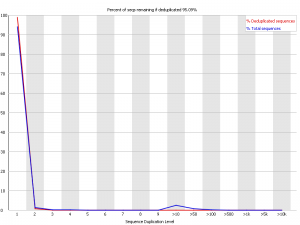
    Also I don't understand what could be the cause of 10+ duplication level?!
    Last thing I don't understand the Kmer graph. I watched a video that one could easily figure out the adapters used for the sequencing but my Kmer graph is so confusing I cannot understand anything!

    Your help would be very much appreciated.
    Parham
    Attached Files
  • mastal
    Senior Member
    • Mar 2009
    • 666

    #2
    Your data looks OK in general, apart from the duplication level.

    Have a look at Simon Andrews' explanation of the duplication level plot:


    What type of experiment is your data from?

    It is quite common to get funny values for the first few bases in the Per base sequence content plot for RNA-Seq experiments. This is thought to be due to the random priming step not actually being quite so random.

    You can figure out how many of your reads contain adapters by using grep.

    Comment

    • Parharn
      Member
      • Jul 2013
      • 84

      #3
      Thanks mastal for reviewing my data. The Simon Andrew's explanation was very helpful to read.
      My experiment is RNA-seq, and I am trying to build a transcriptome. I am new to this field and very confused with many steps.
      Regarding grep, I found adapters in middle of my reads not the beginning. Is that how it usually should be? FYI I don't see Indexes at beginning of my reads. Is that correct?

      Thanks again!

      Comment

      • GenoMax
        Senior Member
        • Feb 2008
        • 7142

        #4
        In case of illumina sequencing the tag is read as a separate "read" and is not part of the actual sequence. Tag reads are taken into account when the illumina pipeline demultiplexes data (tag sequence will be added at the end of the sequence read ID if illumina CASAVA pipeline was used for demultiplexing) ref: http://en.wikipedia.org/wiki/FASTQ_f...ce_identifiers.

        You should not be seeing adapters in the middle of your reads. Are you sure they are real and not "grep" artifacts?

        Comment

        • mastal
          Senior Member
          • Mar 2009
          • 666

          #5
          Most Illumina adapters should be towards the 3' ends of the reads.

          However, there are always some reads where the insert is very short, or where there is no insert at all, so you start reading into the adapter sequence at an earlier point in the read, like at the 5' end of the read in the cases where you have only adapter or adapter dimers and no insert.

          Comment

          • Jeremy
            Senior Member
            • Nov 2009
            • 190

            #6
            Did your protocol use random hexamer priming? That could explain the per base sequence content and kmers (I have seen a similar thing with RNA-seq, but it showed 6-mers not 5-mers). If you need to do a de-novo assembly I would trim the start of the reads, maybe the first 8 nt. As for duplication level, you expect that sort of result with RNA-seq because some genes are in much higher copy number than others making it much more likely to get reads that are identical.

            Comment

            • Parharn
              Member
              • Jul 2013
              • 84

              #7
              No I think I made a mistake about that. Thanks for concidering GenoMax!

              Comment

              • Parharn
                Member
                • Jul 2013
                • 84

                #8
                Jeremy I used random hexamer priming! Could you explain why it should show 6-mers not 5-mers? As a test I trimmed the seqs 5N and 10N and I am attaching their FastQC result. Can you have a look on them please and tell me what you think?
                Attached Files

                Comment

                • mastal
                  Senior Member
                  • Mar 2009
                  • 666

                  #9
                  By default FastQC shows 5-mers. You can change the k-mer size to anything between 2 and 10 using the -k flag. But you may need to give it more memory if you use a larger k-mer size.

                  Comment

                  Latest Articles

                  Collapse

                  • SEQadmin2
                    Advanced Sequencing Platforms Tackle Neuroscience’s Toughest Genomics Problems
                    by SEQadmin2


                    Genomics studies in neuroscience face a special challenge due to the brain’s complexity and scarcity of samples. Mapping changes in cell type and state using conventional next-generation sequencing methods remains challenging. Advances in technologies like single-cell sequencing, spatial transcriptomics, and long-read sequencing have opened the door to deeper studies of the brain and diseases like Alzheimer’s, amyotrophic lateral sclerosis (ALS), and schizophrenia.
                    ...
                    07-09-2026, 11:10 AM
                  • SEQadmin2
                    Cancer Drug Resistance: The Lingering Barrier to Rising Survival
                    by SEQadmin2


                    Cancer survival rates have significantly increased in the last few decades in the United States, reaching a combined 70% 5-year survival rate by 2021. Behind this number, there are years of research to find new therapies, drug targets, and early detection methods. But there is one core challenge that keeps slowing down these advances, and it’s about drug resistance.

                    There is no single reason why many patients don’t respond to treatment as expected. Cancer is...
                    07-08-2026, 05:17 AM
                  • GATTACAT
                    Reply to Nine Things a Sample Prep Scientist Thinks About Before Sequencing
                    by GATTACAT
                    Love this - good data definitely starts from good input, and poor input can only give relatively poor data. I particularly like the mention of Nanodrop/absorbance based methods for quantification. It's such a toss up if you'll get an accurate reading or what amounts to a randomly generated number, and a lot of library/sequencing related issues can be traced back to poor quant.
                    07-01-2026, 11:43 AM

                  ad_right_rmr

                  Collapse

                  News

                  Collapse

                  Topics Statistics Last Post
                  Started by SEQadmin2, Yesterday, 10:26 AM
                  0 responses
                  13 views
                  0 reactions
                  Last Post SEQadmin2  
                  Started by SEQadmin2, 07-09-2026, 10:04 AM
                  0 responses
                  26 views
                  0 reactions
                  Last Post SEQadmin2  
                  Started by SEQadmin2, 07-08-2026, 10:08 AM
                  0 responses
                  16 views
                  0 reactions
                  Last Post SEQadmin2  
                  Started by SEQadmin2, 07-07-2026, 11:05 AM
                  0 responses
                  33 views
                  0 reactions
                  Last Post SEQadmin2  
                  Working...