
My company wants to buy a bioinformatics workstation. I am looking at Knosys, Bina, CLC Bio and Ayrris. Does anyone here have one of these systems? What do you think of it? Do you have any recommendations?
-
-
Are you interested in Software packages or hardware? -
Is there a specific business need/reason to consider canned example "workstation" like ones you have mentioned? Otherwise buying a generic workstation from your companies favorite vendor and then installing software (if you must have commercial software then that can be installed) on it would be the way to go.Last edited by GenoMax; 08-26-2014, 07:58 AM.Comment
-
Isn't it a hassle managing all the different software packages? Was wondering about others'experiences with the pre-built pipelines from eg Bina? I'm mostly interested in software but will need hardware anyway so was thinking it might be easiest to tackle it all at once.Last edited by norbert; 08-26-2014, 09:17 AM.Comment
-
That is subjective. We consider keeping up with the cycles of new software releases a part and parcel of stuff a bioinformatician doesOriginally posted by norbert View Post
You could farm out the entire analysis to an external provider (there are several in the NGS "cloud-based analysis" area) and not worry about doing anything locally (sounds like you will be ok with a preset analytic pipeline).Comment
-
We have data privacy constraints which mean that we prefer to do the analysis in-house.Comment
-
Norbert,
I will try to offer my somewhat informed opinion on this. Of what 'pre-packaged' commercial solutions there might be for bioinformatics analysis, they can be somewhat lacking and/or dated.
It has been said that the best tool is not necessarily one, but the consensus among tools. Yes it is a bit of a mess but as stated above keeping up with it is part of what a bioinformatician does. Even through the chemistry and hardware (namely the sequencer) are well validated and commercial, much of what comes after that is open source and continually evolving. It depends on what you want to do, one of the software packages in your original post may fit the bill.Comment
-
Even if someone recommends one package over others ultimately you will have to test the on-site appliances yourself. Any or all of those packages will give you answers but only you can decide if the package addresses your unique requirements.Comment
-
Hi,
We bought a workstation from CYBERTRONPC for $4500 - 16 core AMD + 128 GB ECC RAM + 120 GB SSD boot + 4 TB RAID.
Then we installed BIOLINUX - single click updates ALL of the open source software. We then purchased CLC Genomics Workbench.
Total cost => about $11,000 for a pretty swank bioinformatics workstation.
Regards,
AndorComment
-
The problem I find with any single pipeline or single commercial package is that data is too varied. There is no one size fits all when it comes to the best or most appropriate tool for analyzing a given data set.
Usually, any data set requires a bit of exploratory analysis and then decisions about how best to analyze it. Relying on one single analyses pre-built pipeline could often mean you are not really analyzing your data to the best of what is capable.
With modern genomics data, I really think it is essential to be flexible with your choice(s) of analysis. That inherently means someone needs to be able to install, test and update tools as necessary, not as is convenient or easy.
Just my $0.02's worth.Michael Black, Ph.D.
ScitoVation LLC. RTP, N.C.Comment
-
The choice of hardware and software will depend a lot on the problem and nature of data you are working with. For me I always want the option of customizing the environment: from OS to any open source/commercial application.
Earlier this year we've acquired a HP BL660c Blade with 16 cores, 512GB RAM and ~50TB RAID, which cost us ~$30,000. We mainly use it for small to medium sized plant genome assembly (de novo) and related NGS and comparative genomics problems. It's a linux machine with almost everything open source except a commercial CLC workbench. I think If your institution/company do not have a policy with brand/vendor etc. you can easily custom built a similar machine like mine with half the cost.Comment
-
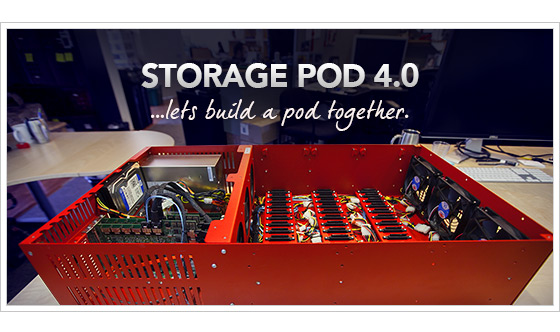
I still want a few of these ...
Comment
-
8 TB drives were announced by Seagate recently http://www.seagate.com/about/newsroo...ves-pr-master/. Those would go nicely with the backblaze.Originally posted by Richard Finney View PostComment
-
Only if the drives are cheaper than 2 4TB drives (plus a bit more for enclosure, power, and storage space). Backblaze try to reduce their cost per GB (considering drive lifetime, power, capacity, etc.), not their cost per drive.Those would go nicely with the backblaze.
Oh, by the way, if you do actually want a backblaze-like storage pod, you can order them for a little under $5500 (not including drives) from the people who manufacture them for backblaze:
Comment
-
Since you are purchasing commercial software I would recommend buying a package which handles all formats of data. Some of the listed vendors only support Illumina fastq data.Comment




-
Tumors contain complex mixtures of cell populations that evolve in response to treatment and host-specific factors. Tissue biopsies provide only static snapshots of a tumor’s state. But what if we could follow that evolution over time using a minimally invasive technique?
Liquid biopsies can detect tumor-derived material circulating in the bloodstream, providing a way to study treatment response, detect emerging resistance, and discover new biomarkers. Circulating...10-14-2026, 09:55 AM -
Researchers using sequencing and genomics tools often have to make trade-offs. They can choose between speed or scale, short reads or long-range information, or targeted panels or a view of the whole transcriptome. New technologies that have been released this year are built to address those tough choices.
We asked six companies the same four questions to learn about their latest products. The new technologies bring a lot to the table, including rethinking sequencing...
Comment