Unconfigured Ad

Collapse
X
 
  • Filter
  • Time
  • Show
Clear All
new posts
  • vruotti
    Member
    • Feb 2008
    • 13

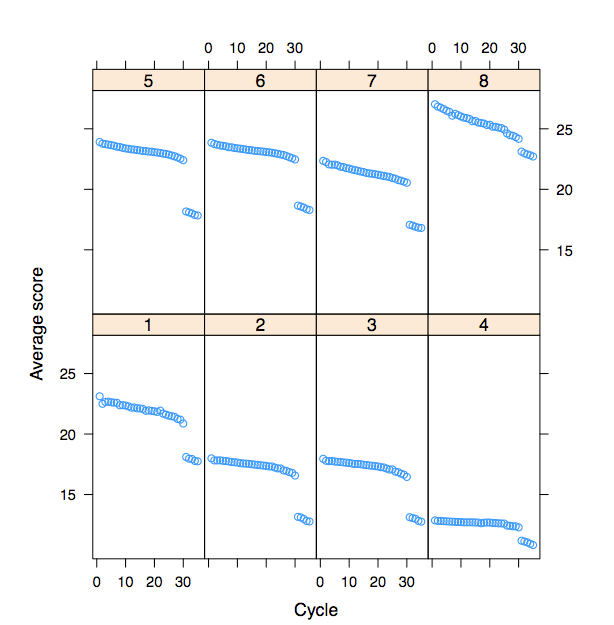
    Quality score graph

    Just wondering if anyone have seen the same problem with cycle 30.
    Thanks,
    Victor
  • new300
    Member
    • Mar 2008
    • 50

    #2
    it's not normal. This is for a single run? If you have the images look at the images, see if they get dimmer or something else strange happens at cycle 30. If you don't have the images then look at the intensity plots, do you have a significant drop in average intensity around cycle 30? What do the error rates for cycle 30+ look like on the control lane?

    Comment

    • glacerda
      Member
      • Aug 2008
      • 27

      #3
      This is Solexa, right?
      If it is, maybe you would like to look at that
      maybe you would like to look at that:

      Substantial biases in ultra-short read data sets from high-throughput DNA sequencing. 2008, July. Nucl. Acids Res.

      []s
      glacerda

      Comment

      • TylerBackman
        Member
        • Oct 2008
        • 13

        #4
        I already posted this answer in the other thread where you asked about this, but I thought I'd post it here as well. This is possibly an artifact of the Illumina pipeline quality score normalization rather than an actual sudden drop in quality.

        This is most likely because the qualities you are looking at are alignment normalized, and a large number of your sequences failed to align to the reference genome (due to a ligated adapter, etc.)

        Take a look at the un-normalized scores (s_<lane>_qraw.txt) instead, I think you'll find that the curve is more continuous between cycles.
        @1
        NNNNNNNNNNNNNNNNNNNNNNNNNNNNNNNNNNNN
        +
        """"""""""""""""""""""""""""""""""""

        Comment

        Latest Articles

        Collapse

        • SEQadmin2
          Nine Things a Sample Prep Scientist Thinks About Before Sequencing
          by SEQadmin2


          I’m not a sequencing expert. I’m a purification scientist who uses NGS to evaluate workflows my group develops. With this perspective, we think about the sample first and the NGS workflow second. The sequencer is an exceptionally honest reporter, but it can only report on what you give it, so whether you get clean, interpretable data from an NGS workflow is largely determined before you begin.


          Here are nine questions we think about, in roughly the order they matter, before...
          06-18-2026, 07:11 AM
        • SEQadmin2
          From Collection to Sequencing: Why Sample Preparation and Preservation Define Sequencing Data
          by SEQadmin2


          Data variability is still an issue in sequencing technologies despite the advances in reproducibility and accuracy of these platforms. But the problem does not originate in the sequencing itself, but in the previous steps, before the sample reaches the sequencer.


          The first step is collection, followed by preservation and sample preparation for analysis. Most scientists overlook those steps, but not being careful might just be skewing the experiment’s results.
          ...
          06-02-2026, 10:05 AM

        ad_right_rmr

        Collapse

        News

        Collapse

        Topics Statistics Last Post
        Started by SEQadmin2, 06-17-2026, 06:09 AM
        0 responses
        24 views
        0 reactions
        Last Post SEQadmin2  
        Started by SEQadmin2, 06-09-2026, 11:58 AM
        0 responses
        42 views
        0 reactions
        Last Post SEQadmin2  
        Started by SEQadmin2, 06-05-2026, 10:09 AM
        0 responses
        48 views
        0 reactions
        Last Post SEQadmin2  
        Started by SEQadmin2, 06-04-2026, 08:59 AM
        0 responses
        49 views
        0 reactions
        Last Post SEQadmin2  
        Working...