Unconfigured Ad

Collapse
X
 
  • Time
  • Show
Clear All
new posts
  • Godevil
    Member
    • Feb 2011
    • 22

    #1

    How to Evaluate the Illumina Data Quality?

    Hello everyone!

    I'm a new guy here, and this is my first post.

    I'm doing the de novo assembly work with the Illumina sequencing data (form GAIIx v1.3, pair-end reads 150bp x 2). I find the raw data I got from the bio-company is not so good(shown in the FastQC figure).

    I wonder if there is a criterion in Illunima Company or some other commonly used rules for evaluating the quality of GAIIx sequencing data.

    According to the criterion, if the data quality is bad, I will ask the company to sequence our genome again.

    Thank you very much!
    Last edited by Godevil; 04-03-2011, 04:54 PM. Reason: Re-upload the figure
  • simonandrews
    Simon Andrews
    • May 2009
    • 870

    #2
    Your image seems to have been removed from baidu so I can't see your plot so it's hard to comment specifically.

    150bp is still very long for an Illumina read. I don't think I've yet seen an Illumina run whose quality stayed high to 150bp, with the latest chemistry we're just starting to see runs of ~120bp with high quality to the end. That's not to say that the last 30bp of a 150bp run aren't useful - but you shouldn't be surprised to see the quality decline.

    Comment

    • Godevil
      Member
      • Feb 2011
      • 22

      #3
      Thank you for your reply. I've re-uploaded the FastQC figure.
      I wonder if there is a common used criterion to evaluate the Illummina data quality.

      Comment

      • simonandrews
        Simon Andrews
        • May 2009
        • 870

        #4
        Originally posted by Godevil View Post
        Thank you for your reply. I've re-uploaded the FastQC figure.
        I wonder if there is a common used criterion to evaluate the Illummina data quality.
        I still can't see your figure.

        There's no common set of standards available to evaluate any kind of sequence data. The cutoffs used in FastQC are simply derived from looking at lots of different runs and setting a cutoff where I'd have have wanted to have a closer look. There will be variations between different machines, library types and even chemistry versions which make setting universal cutoffs difficult. We're always open to suggestions for ways to improve things.

        Comment

        • Godevil
          Member
          • Feb 2011
          • 22

          #5
          Originally posted by simonandrews View Post
          I still can't see your figure.
          I tried again to use another album on the Internet. I hope you can see this figure now.

          I'm a new guy here. I don't know if I can upload a figure as an attachment in SEQanswers. Figure's URL from the internet album is always unstable. Which album do you often use?

          Figure's URL:


          or

          Comment

          • simonandrews
            Simon Andrews
            • May 2009
            • 870

            #6
            OK, I can see it now. It actually doesn't look bad at all. Your quality looks OK up to about 125bp and only drops right at the end. 150bp runs have only been supported relatively recently and it's not surprising to see a drop in the last few bases. We've only just started to see data which looked to be high quality past 100bp, and your data runs well past that.

            This actually looks like very nice data from a very ambitious run. I'd be very happy with my sequencing provider if they could routinely produce data this good.

            Comment

            • Godevil
              Member
              • Feb 2011
              • 22

              #7
              Originally posted by simonandrews View Post
              It actually doesn't look bad at all.
              Thank you for your reply
              The figure we discussed is the "per base sequence quality" which is not good enough through the evaluation of FastQC.

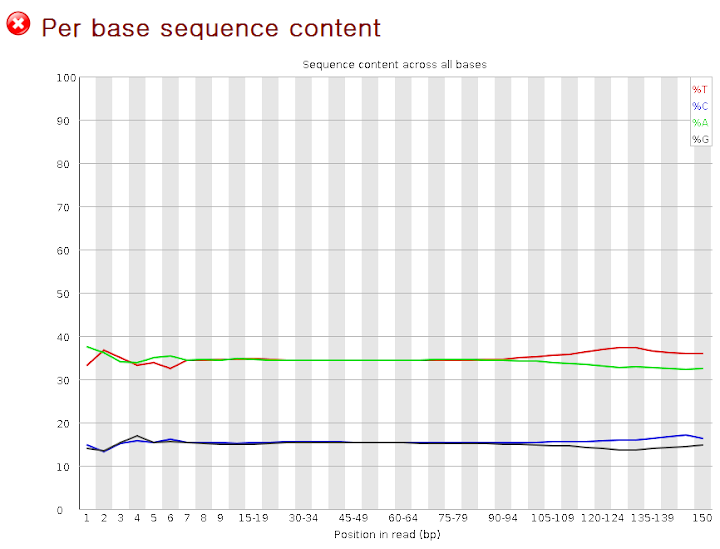
              The following figure is the statistic results from the FastQC.


              This software tells me that the sequencing result is not so good, so I wonder if there is a common criterion for evaluating the sequencing data quality.

              I also believe it would be OK if I only use the first 100bp in the reads. However, my problem is that our lab paid extra money for the 150bp reads. It is expensive to get the long reads than 100bp reads. So, I wonder if this sequncing data is OK, or we should ask the company to do the sequencing again.
              Last edited by Godevil; 03-30-2011, 11:30 PM. Reason: re-upload figure

              Comment

              • simonandrews
                Simon Andrews
                • May 2009
                • 870

                #8
                For the quality plot FastQC is warning you that the quality at the end of the read is poor - which it is. What I was trying to do was to put this into context which was that you were running the longest supported read length which Illumina provide. At this length we'd not be surprised to see quality values falling at the end of the read since you're really pushing the limits of the chemistry.

                So I suppose the message is that at the end the quality is poor - but it's probably as good as you were ever going to get (at least for now).

                I can't really comment on the other warnings/failures without seeing the plots which go with them.

                Comment

                • Godevil
                  Member
                  • Feb 2011
                  • 22

                  #9
                  Originally posted by simonandrews View Post
                  I can't really comment on the other warnings/failures without seeing the plots which go with them.
                  Ok, I will show all the figure wich has a red "x" or yellow "!" marker in the FastQC report. Maybe, you can give me some advice.

                  Thank you very much!


                  Comment

                  • simonandrews
                    Simon Andrews
                    • May 2009
                    • 870

                    #10
                    OK, so the Kmers and the Base plots suggest that in a significant proportion of your library you're reading through your insert and into the adapter on the other end. You'll therefore want to use an adapter trimmer to remove this sequence.

                    You have some low level sequence duplication, which could be the result of saturating your library, or could be PCR amplification bias. If you're assembling a small genome then the saturation seems more likely, if it's a large genome then it might be PCR bias. You might want to remove duplicates before assembling, since they'll just slow down the assembly process and won't add any new information to your library.

                    So to summarise, if I were you I'd:

                    1) Trim all of my sequences back to about 125bp to remove the poor quality sequence from the end.

                    2) Run the remaining sequence through an adapter trimmer to remove any remaining adapter (you could do this first)

                    3) Remove duplicate sequences - not because your library is heavily duplicated, but it's probably not a bad idea before any assembly.

                    Hope this helps

                    Simon.

                    Comment

                    • Godevil
                      Member
                      • Feb 2011
                      • 22

                      #11
                      Originally posted by simonandrews View Post
                      1) Trim all of my sequences back to about 125bp to remove the poor quality sequence from the end.

                      2) Run the remaining sequence through an adapter trimmer to remove any remaining adapter (you could do this first)
                      It really useful! Thank you very much!

                      Actually, I've already found ~10% reads have the adapter sequence in their 3' ends. I decide to remove the adapter sequences and perform quality filter with "Cutadapt" software (This software can trim the low quality reads using the same rule as BWA, and then, remove the adapter sequences).


                      Originally posted by simonandrews View Post
                      3) Remove duplicate sequences - not because your library is heavily duplicated, but it's probably not a bad idea before any assembly.
                      But, I don't know which software is the best for me to remove duplicate sequences. Do you have some advice?


                      Your reply is so helpful!

                      Comment

                      • simonandrews
                        Simon Andrews
                        • May 2009
                        • 870

                        #12
                        Originally posted by Godevil View Post
                        But, I don't know which software is the best for me to remove duplicate sequences. Do you have some advice?
                        I've not used it myself, but the picard markduplicates program does this.

                        Comment

                        • robs
                          Senior Member
                          • May 2010
                          • 116

                          #13
                          Take a look at PRINSEQ as well. I would suggest that you use the standalone version if you have large files.


                          http://bioinformatics.oxfordjournals...6/863.abstract

                          Comment

                          • tonybolger
                            Senior Member
                            • Feb 2010
                            • 156

                            #14
                            Originally posted by Godevil View Post
                            Ok, I will show all the figure wich has a red "x" or yellow "!" marker in the FastQC report. Maybe, you can give me some advice.
                            End of read quality: Since you have shortish inserts with long reads, and you see adapters, many reads will need to be trimmed. But i wouldn't advise just cutting each read at a fixed point (unless you have oodles of data to spare) - even if 25% of the reads are usable out to 150bp, those good quality long reads are gold-dust in denovo projects. I'd recommend adapter trimming, N base / B quality trimming, followed by a sliding window quality filter across a few bases.

                            Duplication: Some of this is likely adapter-only reads, or even just the adapter parts of otherwise usable reads. It could also be biological, a contaminant, mitochondria or chloroplast sequence. And even if some reads are identical, this can happen due to common repeats within the target genome without being 'wrong'. Assemblers often rely on such coverage hints to help find repeats.

                            For scaffolding however, especially with mate pair data, remove duplicates, or many copies of a single (possibly wrong) link can be used to link contigs in error.

                            Comment

                            • kga1978
                              Senior Member
                              • Nov 2010
                              • 100

                              #15
                              *BUMP*

                              I'm using FastQC as well (great program - thanks!) and I have noticed that I have significant contaminations of TruSeq adapters. Is there a program that will trim these without me having to specify the adapter sequences themselves? I.e. a program that uses the same sort of information as FastQC to automatically identify and trim them?

                              Thanks - and sorry for the bump!

                              Comment

                              Latest Articles

                              Collapse

                              • SEQadmin2
                                Multiomic Liquid Biopsy: What DNA/RNA Panels Reveal That DNA Alone Can’t
                                by SEQadmin2


                                Tumors contain complex mixtures of cell populations that evolve in response to treatment and host-specific factors. Tissue biopsies provide only static snapshots of a tumor’s state. But what if we could follow that evolution over time using a minimally invasive technique?

                                Liquid biopsies can detect tumor-derived material circulating in the bloodstream, providing a way to study treatment response, detect emerging resistance, and discover new biomarkers. Circulating
                                ...
                                10-14-2026, 09:55 AM
                              • SEQadmin2
                                New Genomics Technologies Take Aim at Long-Standing Limits
                                by SEQadmin2


                                Researchers using sequencing and genomics tools often have to make trade-offs. They can choose between speed or scale, short reads or long-range information, or targeted panels or a view of the whole transcriptome. New technologies that have been released this year are built to address those tough choices.

                                We asked six companies the same four questions to learn about their latest products. The new technologies bring a lot to the table, including rethinking sequencing
                                ...
                                09-28-2026, 10:25 AM

                              ad_right_rmr

                              Collapse

                              News

                              Collapse

                              Topics Statistics Last Post
                              Started by SEQadmin2, 10-22-2026, 11:13 AM
                              0 responses
                              43 views
                              0 reactions
                              Last Post SEQadmin2  
                              Started by SEQadmin2, 10-22-2026, 10:48 AM
                              0 responses
                              33 views
                              0 reactions
                              Last Post SEQadmin2  
                              Started by SEQadmin2, 10-15-2026, 10:52 AM
                              0 responses
                              44 views
                              0 reactions
                              Last Post SEQadmin2  
                              Started by SEQadmin2, 10-14-2026, 05:39 AM
                              0 responses
                              45 views
                              0 reactions
                              Last Post SEQadmin2  
                              Working...