Unconfigured Ad

Collapse
X
 
  • Filter
  • Time
  • Show
Clear All
new posts
  • allerzbulintini
    Junior Member
    • Oct 2016
    • 6

    Issues with ribo-depletion vs poly-A sequencing in brain tissues

    I would like to do an RNAseq comparison between the hippocampus and striatum during contextual fear conditioning. My main interest is to see differential expression for protein coding genes. However, as a side project, I think it would be interesting to see how expression changes for non-coding regions (for example, enhancer RNAs and some of the snRNAs involved in splicing).

    I've analysed ribo-depleted data sets for human cell lines before and didn't have any issues but before going through with sequencing I wanted to make sure that no one else had run into any issues with ribo-depletion with different types of tissues. I haven't seen anything too worrying while searching through other threads but most of these aren't tissue specific. Has anyone else had any specific issues with ribo-depletion and sequencing in the brain (or I would also be interested to hear general sequencing issues with the brain)?

    As a side question, why is poly-A sequencing still so commonly used? It's been shown that non-coding RNAs are prevalent and play a major role in all cell types and I don't understand why people wouldn't just make ribo-depleted libraries so that they could consider those effects on non-coding RNAs. Why isn't ribo-depletion the norm?

    Thanks so much for any suggestions and discussion!
  • cmbetts
    Senior Member
    • Jun 2012
    • 120

    #2
    I've never seen any tissue dependence on rRNA depletion. It's all happening on purified RNA, so unless there's a wacky rRNA isoform not covered by the kit's probe set, it should work fine.
    I've heard that there tends to be more complex splicing patterns in neurons, so maybe doing two-pass alignment to be more accurate on the junctions.
    I'd venture that price and simplicity feature heavily in polyA selection. All of the rRNA depletion kits available are fairly pricey per library and are at least non-trivial to home brew (not that you can't, but it would have a high initial cost that make it only cost effective for high volume labs). Meanwhile, polyA selection kits and beads are cheap as dirt and have straightforward protocols requiring only a few RNase free buffers. Also, if you're only interested in protein coding genes, you get a higher proportion of reads aligning to exons, which gives you more bang for your sequencing buck.

    Comment

    • kmcarr
      Senior Member
      • May 2008
      • 1181

      #3
      Originally posted by allerzbulintini View Post
      IAs a side question, why is poly-A sequencing still so commonly used? It's been shown that non-coding RNAs are prevalent and play a major role in all cell types and I don't understand why people wouldn't just make ribo-depleted libraries so that they could consider those effects on non-coding RNAs. Why isn't ribo-depletion the norm?
      Simplest answer, poly-A enrichment is cheaper.

      Comment

      • allerzbulintini
        Junior Member
        • Oct 2016
        • 6

        #4
        Thanks for you answers! I came from a lab that focused on a specific non-coding RNA and had no issues with funding so I never really thought about how much prep and sequencing costs differed between poly-A and ribo-depleted but that makes sense.

        Originally posted by cmbetts View Post
        Also, if you're only interested in protein coding genes, you get a higher proportion of reads aligning to exons, which gives you more bang for your sequencing buck.
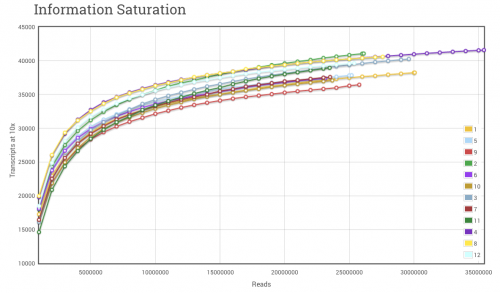
        I've also read about this. In the past, for ribo-depleted samples, the scientists I was working with shot for about 40M reads per sample. I've seen for poly-A people try to get between 20M and 40M reads per sample. Although I haven't had any problems with my genes of interest so far, should I be trying to get more reads for the ribo-dep samples or does 30-40M seem like enough?

        Comment

        • allerzbulintini
          Junior Member
          • Oct 2016
          • 6

          #5
          I've looked around a bit more and for anyone else who is interested, these two articles discuss ribosomal RNA remove and how to choose polyA vs riboDep.

          Since the early days of RNA-seq there has been a heavy focus on the development of effective methods for the removal of ribosomal RNA (rRNA), which account for 95-98% of the transcriptome, from tot…

          Part 2 of our series on RNA-seq. Part 1, Part 3 2. Poly(A) enrichment or ribosomal removal? To continue where we left off yesterday, I sometimes see researchers fretting over whether to do poly(A) …

          Comment

          • debeys
            Junior Member
            • Aug 2012
            • 1

            #6
            Issues with ribo-depletion vs poly-A sequencing in brain tissues

            For whole transcriptome studies including non-coding RNA transcripts there is an alternative method to bead-based Ribo-Depletion.
            NuGEN uses Insert Dependent Adaptor Cleavage Technology (InDA-c) to deplete rRNA transcripts on the library level rather than on the RNA level.
            The InDA-C approach has several advantages in comparison to bead-based Ribo-Depletion methods, e.g. no risk of loss or degradation of the initial RNA sample, more specific depletion of the target transcripts and less RNA input amounts are needed. Additionally the InDA-C method is not restricted to rRNA transcripts but can be customized to any other unwanted transcripts and species.

            Below is a link to the available NuGEN system using the InDA-C technology:

            Comment

            Latest Articles

            Collapse

            • SEQadmin2
              Advanced Sequencing Platforms Tackle Neuroscience’s Toughest Genomics Problems
              by SEQadmin2


              Genomics studies in neuroscience face a special challenge due to the brain’s complexity and scarcity of samples. Mapping changes in cell type and state using conventional next-generation sequencing methods remains challenging. Advances in technologies like single-cell sequencing, spatial transcriptomics, and long-read sequencing have opened the door to deeper studies of the brain and diseases like Alzheimer’s, amyotrophic lateral sclerosis (ALS), and schizophrenia.
              ...
              07-09-2026, 11:10 AM
            • SEQadmin2
              Cancer Drug Resistance: The Lingering Barrier to Rising Survival
              by SEQadmin2


              Cancer survival rates have significantly increased in the last few decades in the United States, reaching a combined 70% 5-year survival rate by 2021. Behind this number, there are years of research to find new therapies, drug targets, and early detection methods. But there is one core challenge that keeps slowing down these advances, and it’s about drug resistance.

              There is no single reason why many patients don’t respond to treatment as expected. Cancer is...
              07-08-2026, 05:17 AM
            • GATTACAT
              Reply to Nine Things a Sample Prep Scientist Thinks About Before Sequencing
              by GATTACAT
              Love this - good data definitely starts from good input, and poor input can only give relatively poor data. I particularly like the mention of Nanodrop/absorbance based methods for quantification. It's such a toss up if you'll get an accurate reading or what amounts to a randomly generated number, and a lot of library/sequencing related issues can be traced back to poor quant.
              07-01-2026, 11:43 AM

            ad_right_rmr

            Collapse

            News

            Collapse

            Topics Statistics Last Post
            Started by SEQadmin2, 07-13-2026, 10:26 AM
            0 responses
            25 views
            0 reactions
            Last Post SEQadmin2  
            Started by SEQadmin2, 07-09-2026, 10:04 AM
            0 responses
            34 views
            0 reactions
            Last Post SEQadmin2  
            Started by SEQadmin2, 07-08-2026, 10:08 AM
            0 responses
            22 views
            0 reactions
            Last Post SEQadmin2  
            Started by SEQadmin2, 07-07-2026, 11:05 AM
            0 responses
            34 views
            0 reactions
            Last Post SEQadmin2  
            Working...