Unconfigured Ad

Collapse
X
 
  • Time
  • Show
Clear All
new posts
  • delphi_ote
    Junior Member
    • Oct 2010
    • 9

    #1

    Are Illumina library fragment lengths actually normally distributed?

    I see in many bioinformatics papers assumptions that the fragment lengths for Illumina data are be normally distributed. I've seen some datasets for which this doesn't seem to be the case, however. I've seen what look like very skewed and bimodal distributions in some of the 1000 Genomes Project data.

    I'm a computer scientist, so I don't know much about what to expect this data to look like or why it would have a given fragment length distribution. I've been searching for the past couple days for a reference, but I've come up empty.

    Is there anyone here that can help me understand this better or point me to a resource where I could learn more? Any help would be greatly appreciated!
  • krobison
    Senior Member
    • Nov 2007
    • 734

    #2
    A lot of this is going to depend on how the library was prepared in terms of size selection.

    For example, one technique is to use electrophoresis to sort by size & then cut out a specific band. These sorts of libraries may have a size distribution which is very close to uniform within very specific bands -- i.e. you might have essentially nothing larger or smaller than a defined range. The reality is probably a little bit of blurring of that boundary, but I'm guessing not a lot.

    Size selection with beads, on the other hand, probably isn't quite as sharp and perhaps is more like a normal (I haven't looked). Nextera would probably be different again. Some libraries prep protocols I think rely solely on the shearing device to generate a population.

    Too many papers fail to report how this is done, so if you wanted to study this you'll need to dig through a bunch of papers to find those that report their methods. But I would guess if you looked through a lot of papers, you'd find a bunch of different distributions. Perhaps if you can identify the center which did each sequence in 1K genomes, you'd see a different distribution which corresponds to their method.

    Comment

    • delphi_ote
      Junior Member
      • Oct 2010
      • 9

      #3
      Thank you so much, krobison! That was incredibly informative, and pointed me toward a lot of good resources. I really appreciate it.

      Comment

      • gogreen
        Member
        • Apr 2009
        • 18

        #4
        hi delphi_ote, Krobison was right with the point. If one uses Gel selection or other automated size selection methods, the size selected fragments are mostly in X±30 bp where X is the selected size.
        But when beads are used for size selection, this can be quite a large distribution typically ranging over a 100 bp or more of the desired size.
        Attached are 2 bioanalyzer profiles of two libraries. One using Gel size selection and other using beads (The bead size selection can do a better job than this, I just found this one first)
        Attached Files

        Comment

        • pmiguel
          Senior Member
          • Aug 2008
          • 2328

          #5
          To add another twist, sometimes one of the methods we use to size fractionate DNA, E-gel, has too narrow a size window, so we do a few collections.

          Well, that may not be clear... These E-gels have a slot in the gels with no agarose in it--just water or buffer some distance from the loading well. The DNA migrates first into the agarose of the gel, where it migrates at differential rates largely determined by length of the DNA fragment. When it reaches the collection slot it migrates through this window, continuing on back into the gel on the other side. Once the desired size range of DNA is migrating through the window the gel is stopped and the fraction is pulled out with a pipette.

          But the well can be filled back in and electrophoresis continued, and then another fraction taken at a later time. This can easily result in bimodal (or multi-modal) size distributions if the resulting fractions are pooled at a later point.

          I don't know how common this practice is, but in cases where there is concern for the limited amount of library being produced I would imagine it would be common.

          --
          Phillip
          Last edited by pmiguel; 05-10-2011, 02:50 AM.

          Comment

          • delphi_ote
            Junior Member
            • Oct 2010
            • 9

            #6
            Every time I ask people who do the hard work, I always learn the real story. Thanks so much, gogreen and pmiguel. Clearly, this community was the right one to ask!

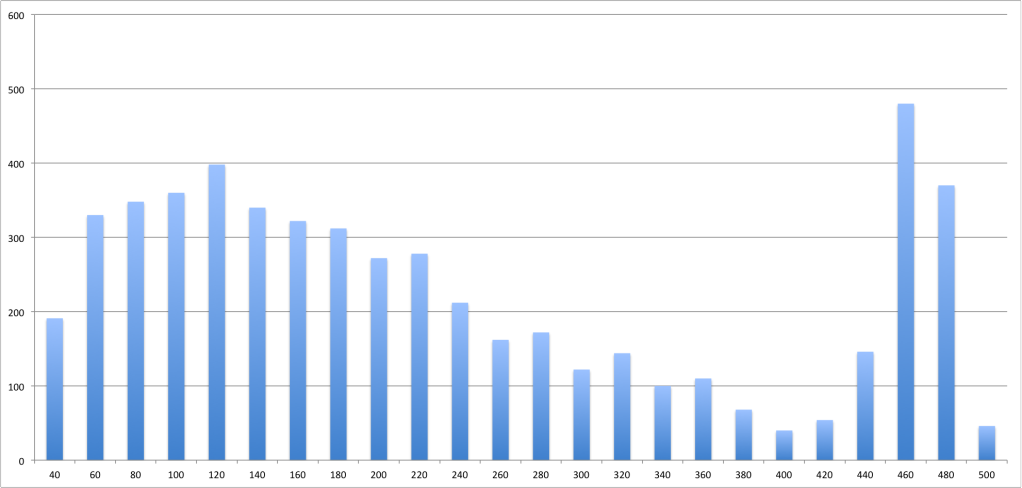
            Do you know if any of these library preparation techniques would cause the desired fragment lengths to be 100bp or more less than the desired size? A few of the libraries I've been examining seem like they're not only bimodal, but also significantly shorter. For example, here's a graph I made for a library that was designed to be 614bp:


            Any idea what would cause this?

            Comment

            • gogreen
              Member
              • Apr 2009
              • 18

              #7
              When you say 612 bp, is it the mean insert size or the size that was gel selected? If it was the selected size, you'd lose around 120 bp for the adapters on both ends which would explain why you get insert size of 440-500 bp. The smaller ones could be the self ligated adapters which typically appears at 120-135 bp (although theoretically not possible, it does happen!). Is this from some modified RNAseq or chipseq??

              Comment

              Latest Articles

              Collapse

              • SEQadmin2
                Beyond CRISPR/Cas9: Understand, Choose, and Use the Right Genome Editing Tool
                by SEQadmin2


                CRISPR/Cas9 sparked the gene editing revolution for both research and therapeutics.1 But this system still showed severe issues that limited its applications. The most prominent were the heavy reliance on PAM sequences, delivery limitations, double-stranded breaks that prompt unintended edits and cell death, and editing inefficiency (both in targeting and in knock-in reliability).

                Despite this, “CRISPR helped turn genome editing from a specialized technique into
                ...
                07-31-2026, 11:01 AM
              • SEQadmin2
                Proteomic Platforms: How to Choose the Right Analytical Strategy to Improve Detection and Clinical Applications
                by SEQadmin2


                Proteomics platforms are evolving rapidly, with advances in mass spectrometry and affinity-based approaches expanding what researchers can detect and at what scale. As the field moves toward deeper proteome coverage and clinical applications, scientists face an increasingly complex landscape of tools. This article will explore how researchers are navigating these choices to find the right platform for their work.

                The systematic characterization of the human proteome has
                ...
                07-20-2026, 11:48 AM
              • SEQadmin2
                Advanced Sequencing Platforms Tackle Neuroscience’s Toughest Genomics Problems
                by SEQadmin2


                Genomics studies in neuroscience face a special challenge due to the brain’s complexity and scarcity of samples. Mapping changes in cell type and state using conventional next-generation sequencing methods remains challenging. Advances in technologies like single-cell sequencing, spatial transcriptomics, and long-read sequencing have opened the door to deeper studies of the brain and diseases like Alzheimer’s, amyotrophic lateral sclerosis (ALS), and schizophrenia.
                ...
                07-09-2026, 11:10 AM

              ad_right_rmr

              Collapse

              News

              Collapse

              Topics Statistics Last Post
              Started by SEQadmin2, 08-03-2026, 10:13 AM
              0 responses
              21 views
              0 reactions
              Last Post SEQadmin2  
              Started by SEQadmin2, 07-31-2026, 02:55 AM
              0 responses
              34 views
              0 reactions
              Last Post SEQadmin2  
              Started by SEQadmin2, 07-24-2026, 12:17 PM
              0 responses
              25 views
              0 reactions
              Last Post SEQadmin2  
              Started by SEQadmin2, 07-23-2026, 11:41 AM
              0 responses
              21 views
              0 reactions
              Last Post SEQadmin2  
              Working...