-
Looking at the positions of the sequences, I would see if the sequences: CAGCACCAGCA or CAGCACCACC are part of your primers. -
I agree. Probably reflects a sequence bias for the transposase used by Nextera. It will have its own agenda -- and it may not correspond perfectly with yours. But is it good enough? Assemble and see...
--
PhillipLeave a comment:
-
I have seen Nextera libraries show a very similar bias. My guess is that this is just an artifact of the library prep. In the past, I would trim off these regions before mapping, but then I found that it didn't make a big difference, so I just left them there.Leave a comment:
-
Is this RNA-Seq? If so, this looks like it could be the result of random hexamer priming. Does the nucleotide distribution look off at the beginning too?
Hansen, K. D., S. E. Brenner, et al. (2010). "Biases in Illumina transcriptome sequencing caused by random hexamer priming." Nucleic Acids Research 38(12): e131.Leave a comment:
-
Overrepresented kmers at the start of reads
I recently just discovered FastQC and I ran it in one of our datasets that's having difficulty in assembly. I was wondering how to interpret this piece of result from FastQC
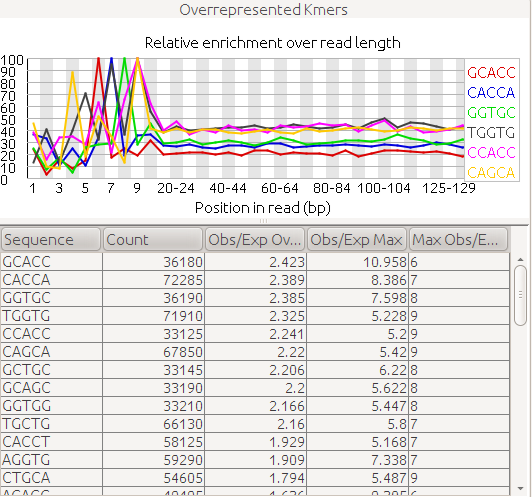
Any ideas?


-
NGS has revolutionized clinical microbiology by offering new ways to identify and surveil pathogens without prior knowledge of the target. One popular approach is 16S rRNA and ITS amplicon sequencing, which targets specific microbial markers. But studies are increasingly incorporating shotgun metagenomics, a technique that sequences all DNA from a sample without targeting specific microbial markers. This approach allows more detailed taxonomic classification, detection...10-30-2026, 06:46 AM -
Tumors contain complex mixtures of cell populations that evolve in response to treatment and host-specific factors. Tissue biopsies provide only static snapshots of a tumor’s state. But what if we could follow that evolution over time using a minimally invasive technique?
Liquid biopsies can detect tumor-derived material circulating in the bloodstream, providing a way to study treatment response, detect emerging resistance, and discover new biomarkers. Circulating...10-14-2026, 09:55 AM
Leave a comment: