
Originally posted by HeinKey
View Post
-
They still need to be quantified. Assuming similarity of HiSeq 4000 flow cell to HiSeq x, they can be overloaded which will reduce the reads %PF. Low loading will increase the number of duplicate reads. Illumina manual also states that underloading can reduce or result in unacceptable %PF. Loading is depend on library type (Nano or PCR-free). -
Remembering back to the HiseqX announcement the little holes that now hold the clustering oligos (which is why this is a "patterned" flowcell) allow 1 oligo to overpower any others that try to cluster in there. I suppose you could somehow get it to overcluster but it wouldn't be the same kind of overclustering we are used to.
Clustering still appears to be on the cBot.
Here's some back-of-excel calcs I did on prices posted for the new 3k/4k reagents. Throughput assumptions are made based on average numbers given by Illumina in their specs and 8-lane FCs.
Leave a comment:
-
Can these new flow cells still be overloaded, or has Illumina created the ideal clustering procedure? Just load your library at high concentration for maximal occupance of the flow cell "wells" and skip qPCR and titration.....
Anything known about the clustering procedure yet?Leave a comment:
-
I know nobody here cares about microarrays (nor should we?), but I think Illumina deserves some serious mad-scientist points for the NextSeq 550. If I'm understanding correctly, they've made a microarray adapter that fits in the flow-cell slot, and are reading it with the same scanner. More innovation than I'd expect from a company with a secure monopoly.
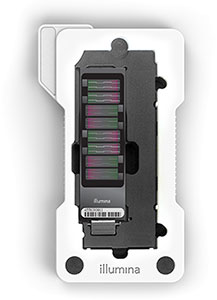
Maybe this is an attempt to wean the last few stragglers off arrays and get them into sequencing?Leave a comment:
-
The one difference with these machines is the throughput. A university facility needed 2 flow cells that could be run independently to help manage a queue, since a paired end run would be almost two weeks (less now). But if most runs are 1-3 days, then that is less of a problem. I suspect the 3000 won't be substantially cheaper so it won't be appealing since you might as well get twice the capacity for a little extra, but some of the other reasons are less important for these machines.Leave a comment:
-
"The 3000 is to the 4000 as the 1000 was to the 2000 and the 1500 to the 2500" Nice summary here: https://biomickwatson.wordpress.com/...00-in-context/
- GenohubLeave a comment:
-
It looks to me that the 3000/4000 only accept 8 lane flow cells (high-output). If true then the trade off for throughput is flexibility.Leave a comment:
-
#SNPsaurus:
I assume it will be 2x 150 bp in 3.5 days.
2.1 to 2.5 billion clusters per flow cell, in a 2x150 bp run is 630 - 750 Gb.
With a speed >200Gb per day a 2x 150 bp run will take 3.5 days.
I wonder if we can upgrade the 2500 V4 machine to a 4000 version...Leave a comment:
-
Heard from someone that the cluster and reagent kits are similar in price to current Hiseq 2000 reagents, which would mean the price per read is quite a bit lower.Leave a comment:
-
There are data from PCR-free, RNA-Seq and NRC libraries sequenced on HiSeq 4000 in BaseSpace.Leave a comment:
-
This http://blog.illumina.com/blog/illumi...eq-4000-system says the 4000 uses 4-color.
This http://www.illumina.com/content/dam/...0-2014-057.pdf says that 1 flowcell does 50 transcriptomes per run at 50M reads each, so that is >300M reads per lane. Looks faster as well, if the longest run time is 3.5 days (not sure if that would be for 1x150bp or 2x150bp).Leave a comment:


-
NGS has revolutionized clinical microbiology by offering new ways to identify and surveil pathogens without prior knowledge of the target. One popular approach is 16S rRNA and ITS amplicon sequencing, which targets specific microbial markers. But studies are increasingly incorporating shotgun metagenomics, a technique that sequences all DNA from a sample without targeting specific microbial markers. This approach allows more detailed taxonomic classification, detection...10-30-2026, 06:46 AM -
Tumors contain complex mixtures of cell populations that evolve in response to treatment and host-specific factors. Tissue biopsies provide only static snapshots of a tumor’s state. But what if we could follow that evolution over time using a minimally invasive technique?
Liquid biopsies can detect tumor-derived material circulating in the bloodstream, providing a way to study treatment response, detect emerging resistance, and discover new biomarkers. Circulating...10-14-2026, 09:55 AM
Leave a comment: