Unconfigured Ad

Collapse
X
 
  • Time
  • Show
Clear All
new posts
  • naleph
    Junior Member
    • Feb 2017
    • 5

    #1

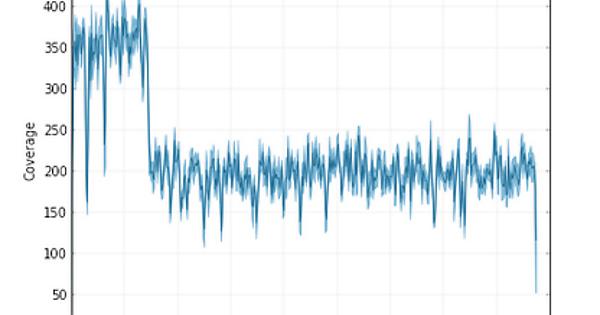
    Uneven coverage across scaffold

    Hi,

    I have run the SMRT-Portal RS_HGAP_Assembly.2 protocol.
    I am getting a single whole chromosome assembled (~4.4Mb) but there is uneven coverage across the scaffold.

    See Figure:
    Discover the magic of the internet at Imgur, a community powered entertainment destination. Lift your spirits with funny jokes, trending memes, entertaining gifs, inspiring stories, viral videos, and so much more from users.


    Additionaly the start 15Kb and the 15Kb where the coverage drops is a repeat.

    I am unsure how to interperate these results and I am wondering if there has been a misassembly.

    Could anyone shed some light on this?
  • Brian Bushnell
    Super Moderator
    • Jan 2014
    • 2709

    #2
    You appear to have a 750kb collapsed repeat at the beginning, which is why the coverage is doubled.

    Comment

    • naleph
      Junior Member
      • Feb 2017
      • 5

      #3
      I had thought of this scenario but duplication of almost a quarter of the genome is highly unlikely and illumina sequencing produces even coverage across the genome. Is it possible that a large segment of the genome was unevenly sequenced with PacBio?

      Comment

      • Brian Bushnell
        Super Moderator
        • Jan 2014
        • 2709

        #4
        Could be a plasmid with two copies, or a plasmid that replicates part of the main chromosome. PacBio does not normally produce uneven coverage; it's very flat. Can you post a picture of the Illumina coverage?

        Comment

        • naleph
          Junior Member
          • Feb 2017
          • 5

          #5
          Sure! here it is:

          Discover the magic of the internet at Imgur, a community powered entertainment destination. Lift your spirits with funny jokes, trending memes, entertaining gifs, inspiring stories, viral videos, and so much more from users.


          Also the organism doesn't have a plasmid.
          Thanks for your help.

          Comment

          • SylvainL
            Senior Member
            • Feb 2012
            • 180

            #6
            Is it supposed to be a linear or circular genome?

            Comment

            • naleph
              Junior Member
              • Feb 2017
              • 5

              #7
              The genome is Circular

              Comment

              • HESmith
                Senior Member
                • Oct 2009
                • 512

                #8
                1) What is the organism that you're studying? And are there any related genomes that might be useful for comparison?

                2) Is there any possibility that the sample might be heterogeneous/contaminated, and that the 750kbp segment is from a different species or symbiont? It might be informative to compare the GC content of that segment to the remainder of the chromosome. Kmer plots and BLAST searches might also prove useful.

                3) And any chance that the Illumina dataset was normalized?

                Comment

                Latest Articles

                Collapse

                • SEQadmin2
                  16S/ITS Profiling vs. Shotgun Metagenomics: What Changes in Your Workflow?
                  by SEQadmin2


                  NGS has revolutionized clinical microbiology by offering new ways to identify and surveil pathogens without prior knowledge of the target. One popular approach is 16S rRNA and ITS amplicon sequencing, which targets specific microbial markers. But studies are increasingly incorporating shotgun metagenomics, a technique that sequences all DNA from a sample without targeting specific microbial markers. This approach allows more detailed taxonomic classification, detection...
                  Today, 06:46 AM
                • SEQadmin2
                  Multiomic Liquid Biopsy: What DNA/RNA Panels Reveal That DNA Alone Can’t
                  by SEQadmin2


                  Tumors contain complex mixtures of cell populations that evolve in response to treatment and host-specific factors. Tissue biopsies provide only static snapshots of a tumor’s state. But what if we could follow that evolution over time using a minimally invasive technique?

                  Liquid biopsies can detect tumor-derived material circulating in the bloodstream, providing a way to study treatment response, detect emerging resistance, and discover new biomarkers. Circulating
                  ...
                  10-14-2026, 09:55 AM

                ad_right_rmr

                Collapse

                News

                Collapse

                Topics Statistics Last Post
                Started by SEQadmin2, 10-28-2026, 09:57 AM
                0 responses
                22 views
                0 reactions
                Last Post SEQadmin2  
                Started by SEQadmin2, 10-28-2026, 09:51 AM
                0 responses
                14 views
                0 reactions
                Last Post SEQadmin2  
                Started by SEQadmin2, 10-22-2026, 11:13 AM
                0 responses
                67 views
                0 reactions
                Last Post SEQadmin2  
                Started by SEQadmin2, 10-22-2026, 10:48 AM
                0 responses
                47 views
                0 reactions
                Last Post SEQadmin2  
                Working...